
The Best Offshore Technical Recruiter in 2026 helps businesses hire qualified technical talent faster, reduce recruitment costs, improve candidate quality, and scale engineering teams through dedicated offshore recruiters, AI-powered sourcing, and flexible RPO solutions tailored to growing organizations
The Best Offshore Technical Recruiter in 2026 helps businesses hire qualified technical talent faster, reduce recruitment costs, improve candidate quality, and scale engineering teams through dedicated offshore recruiters, AI-powered sourcing, and flexible RPO solutions tailored to growing organizations
The 2026 Reality Check: Why Technical Recruiting Broke
What Exactly Is an Offshore Technical Recruiter?
The Time Zone Advantage Nobody Talks About
Best Offshore Technical Recruiter Firms in 2026: The Definitive List
Comparison Table: Best Offshore Technical Recruiter Options in 2026
What an Offshore Technical Recruiter Actually Costs in 2026
Offshore Technical Recruiter vs. Staffing Agency vs. RPO: Which Model Fits You?
The 8-Point Framework for Evaluating an Offshore Technical Recruiter
The 90-Day Onboarding Blueprint
Where Offshore Technical Recruiting Genuinely Fails
What Comes Next: Technical Recruiting in 2027 and Beyond
10 Most Frequently Asked Questions About Offshore Technical Recruiters

Hiring the best offshore technical recruiter in 2026 has become the single highest-leverage decision a technology leader can make this year — because the math on domestic technical recruiting has finally broken. Sixty-five percent of technology hiring managers now say finding skilled talent is harder than it was twelve months ago (Robert Half, 2026), the global AI talent shortage has hit a demand-to-supply ratio of 3.2:1 (Second Talent, 2026), and an in-house technical recruiter in a US metro now costs $95,000–$140,000 fully loaded before a single req gets filled. Meanwhile, a dedicated offshore technical recruiter delivers the same sourcing volume, the same screening rigor, and often better candidate throughput for $800–$2,500 per month (Sagan Passport, 2026). This guide unpacks who the best offshore technical recruiters are in 2026, how the model actually works, what it costs, where it fails, and the exact evaluation framework smart engineering leaders are using right now.

Something strange happened to technical hiring between 2024 and 2026. Hiring activity recovered — but hiring difficulty got worse.
Here is the paradox in numbers. AI job postings surged 134% while overall tech postings remain 34% below pre-pandemic levels (HeroHunt.ai, 2026). Application volume has exploded to the point where “too many applicants” is now the second-biggest recruiting challenge cited by talent teams. And yet 45% of employers still report they cannot find qualified candidates (JobsPikr, 2026).
Translation: the funnel is full of noise, and the signal is scarce. A modern technical req might attract 400 applications, of which four are genuinely qualified. Finding those four requires someone to read, screen, assess, and engage — at volume, at speed, and without burning out. That is exactly the job an offshore technical recruiter is built to do.
AI adoption in HR climbed to 43% in 2026, up from 26% in 2024, with recruiting leading the charge and 88% of companies now using AI for initial candidate screening (MSH, 2026). But here is the uncomfortable truth buried in that same research: only 5% of organizations rate their talent acquisition function as world-class. Tools alone are not solving this. Skilled human recruiters operating those tools are.
That is the gap the best offshore technical recruiter fills in 2026.

An offshore technical recruiter is a specialized recruitment professional — based in a global talent hub like India, the Philippines, or Latin America — who sources, screens, assesses, and coordinates hiring for technical roles on behalf of a client company, typically in the US, UK, Canada, or Australia. Unlike a generalist staffing coordinator, a technical recruiter understands the difference between a Kubernetes engineer and a Docker enthusiast, can read a GitHub profile critically, and knows which certifications actually signal competence.
The model works in three common structures:
Dedicated recruiter model. You get one or more full-time recruiters working exclusively on your reqs, embedded in your team, using your ATS, your email domain, and your employer brand. This is the model favored by companies with continuous hiring needs. Vanator RPO’s recruiting support operates on this principle.
Sourcing support model. Offshore specialists handle only top-of-funnel work — Boolean searches, LinkedIn Recruiter outreach, resume mining, and initial candidate qualification — feeding a warm pipeline to your internal team. 24/7 sourcing support turns your recruiting into a round-the-clock operation.
Full-cycle RPO model. The offshore partner owns the entire process from intake call to offer acceptance, including technical assessments, interview coordination, and onboarding support. This is where firms like Vanator RPO operate at scale.

Most articles frame time zone differences as a problem with offshore recruiting. That framing is backwards for recruiting specifically — and here is why.
When your offshore technical recruiter in India works their business day, it is your night. They spend those hours sourcing, screening, and scheduling. When you log in at 9 AM EST, a fresh shortlist of vetted candidates is already sitting in your inbox with assessment notes attached. Offshore recruitment enables genuinely round-the-clock operations, meaningfully reducing time-to-fill (Recruiters LineUp, 2026).
For a development team, a 10-hour gap is friction. For a recruiting function, it is a second shift you did not have to hire for.
The best offshore technical recruiters structure a 4–6 hour overlap window for live collaboration — intake calls, candidate debriefs, urgent escalations — and use the non-overlapping hours for heads-down sourcing and screening work. That structure is the whole ballgame. Get it right and you have effectively doubled your recruiting capacity. Get it wrong and you get radio silence for half your workday.

Headquarters: USA | Delivery: India | Model: Dedicated RPO + sourcing support
Vanator RPO leads this list for one reason: depth of technical recruiting bench combined with genuine RPO discipline. With 10,200+ active recruiters and 1,500+ companies served, Vanator operates as a pure recruitment process outsourcing firm — not a staffing agency wearing an RPO badge. Their recruiters work under your brand, in your ATS, following your process.
Coverage spans Information Technology, Healthcare Clinical & Life Sciences, BFSI & Accounting, Engineering, Manufacturing, and Infrastructure. For technical roles specifically, they handle everything from full-stack developers and DevOps engineers to niche SAP, Salesforce, and cybersecurity placements. Their technical virtual assistant offering extends support beyond recruiting into technical operations.
Standout: Scales from a single dedicated recruiter to a 50-person delivery pod without rebuilding the relationship. Contact: (203) 220-2294 | govanator.com

Headquarters: San Francisco | Delivery: Argentina, Brazil, Mexico | Model: Staff augmentation
BairesDev fields 4,000+ AI-augmented, time-zone-aligned developers across 100+ technologies, filtered to roughly the top 1% of applicants, with clients including Adobe, Google, and Pinterest (BOSS Magazine, 2026). Their LatAm footprint means near-perfect overlap with US working hours — the tradeoff being higher cost than Asia-based alternatives.
Best for: Companies that need real-time engineering collaboration, not just a recruiting function.
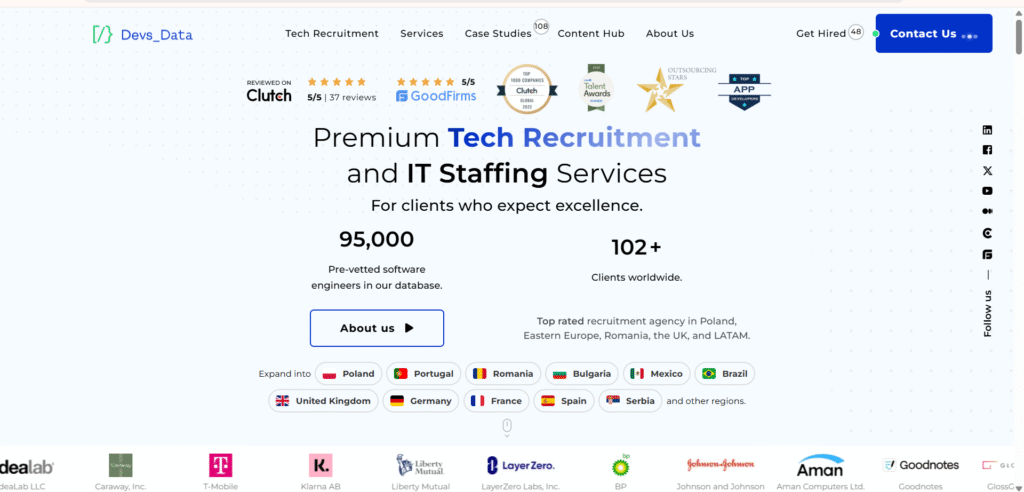
Headquarters: New York | Delivery: Eastern Europe, global | Model: Specialized technical recruitment
DevsData is consistently rated among the top offshore recruitment agencies for tech companies needing offshore software engineers, AI developers, and data scientists (DevsData, 2026). Their multi-step technical screening includes live coding evaluation and system design interviews — closer to what a senior engineering manager would run themselves.
Best for: AI/ML, data engineering, and roles where technical screening depth matters more than volume.
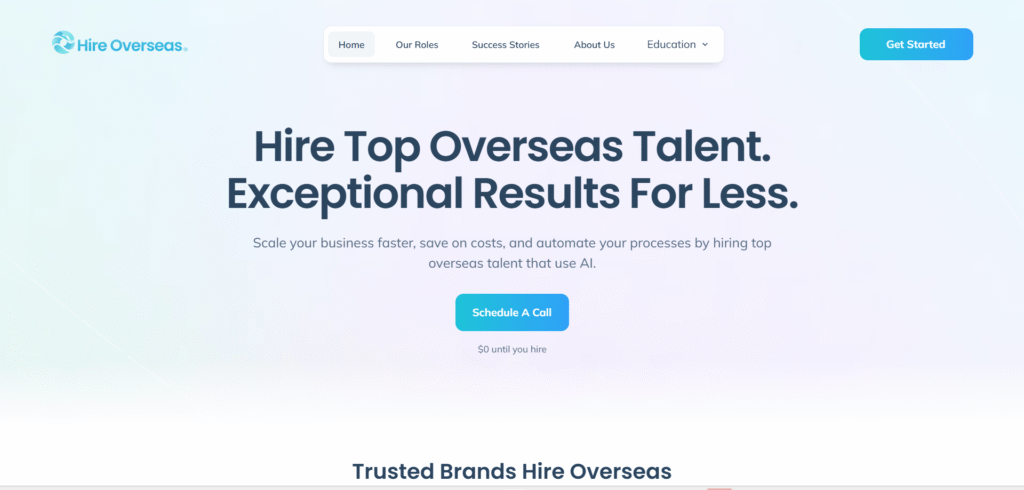
Headquarters: USA | Delivery: Philippines, global | Model: Dedicated full-time talent
Hire Overseas is frequently cited as a top overall pick for offshore hiring in 2026, combining dedicated full-time talent, sub-1% vetting acceptance rates, continuous AI training for placed talent, and transparent month-to-month pricing with no long-term lock-in (BOSS Magazine, 2026).
Best for: Companies wary of 12-month contracts who want to test the model first.

Headquarters: Hanover, MD | Delivery: Global | Model: Staffing + managed services
TEKsystems brings the scale and process maturity that Fortune 500 procurement departments require. Their technical screening frameworks are tailored per client stack, and their global delivery network handles multi-country hiring programs.
Best for: Enterprises with complex vendor requirements, MSP programs, and compliance overhead.
Headquarters: Brookfield, WI | Delivery: Global | Model: Enterprise RPO
Cielo has moved beyond transactional outsourcing into strategic talent partnership, embedding recruiters as extensions of client TA functions with workforce planning and employer branding built in.
Best for: Large organizations rebuilding their entire talent acquisition operating model.

Headquarters: Los Angeles | Delivery: Global | Model: Executive search + RPO
When the role is VP of Engineering, CTO, or Head of AI, Korn Ferry’s executive search practice combined with RPO delivery gives access to passive senior technical leaders that volume recruiters cannot reach.
Best for: Director-level and above technical leadership hiring.

Headquarters: USA | Delivery: Eastern Europe, LatAm | Model: Offshore development center setup
Alcor specializes in helping product companies build entire offshore tech teams from scratch — including legal entity setup, office space, and recruiting (Alcor, 2026).
Best for: Companies committing to a permanent offshore engineering presence
Headquarters: Netherlands | Delivery: 39 countries | Model: Staffing + RPO
Randstad’s global compliance infrastructure removes the legal complexity of hiring technical talent across multiple jurisdictions simultaneously.
Best for: Multinational companies hiring in 5+ countries at once.

Headquarters: India (ISO 9001:2015) | Delivery: India | Model: Staff augmentation
With 400+ tech professionals and 150+ clients, Soft Suave offers ISO-certified delivery at entry-level offshore pricing of roughly $15–$40/hour.
Best for: Startups and SMBs with tight budgets and defined technical scopes.

Provider | Model | Talent Region | Typical Cost | Best For |
Full-cycle RPO | India | Custom / dedicated recruiter pricing | End-to-end technical RPO at scale | |
BairesDev | Staff augmentation | LatAm | Premium | Time-zone-aligned engineering |
DevsData | Specialized recruitment | Eastern Europe | Mid-high | AI, ML, data science roles |
Hire Overseas | Dedicated talent | Philippines | Month-to-month | Testing the model risk-free |
TEKsystems | Staffing + MSP | Global | Enterprise | Fortune 500 procurement |
Cielo | Enterprise RPO | Global | Enterprise | TA transformation |
Korn Ferry | Exec search + RPO | Global | Premium | VP/CTO-level technical hires |
Alcor | ODC setup | E. Europe, LatAm | Project-based | Building offshore R&D centers |
Randstad | Staffing + RPO | 39 countries | Enterprise | Multi-country compliance |
Soft Suave | Staff augmentation | India | $15–$40/hr | Budget-conscious SMBs |

Pricing in offshore technical recruiting falls into four distinct models. Understanding which one you are being quoted is critical, because the effective cost differs by 5x depending on hiring volume.
Contingency fee model: The recruiter charges 15%–25% of the hire’s annual salary, payable only on successful placement. For an $80,000 developer at a 20% fee, that is $16,000 per hire (Sagan Passport, 2026). Best for low-volume, one-off hires.
Dedicated recruiter retainer: You pay $800–$2,500 per month per recruiter for offshore or nearshore talent working exclusively on your reqs. If that recruiter fills 3 roles a month, your effective cost-per-hire drops below $800. This is where the economics get compelling.
RPO per-hire pricing: RPO providers typically charge $3,000–$10,000 per hire, or $8,000–$15,000 per month per recruiter for onshore-managed programs (EOR HQ, 2026). Offshore delivery pushes this toward the lower end.
Hybrid management fee + per-hire: A monthly platform or management fee plus a reduced per-placement fee. Common in mid-market RPO engagements.
The break-even math: if you hire more than 4–5 technical roles per year, a dedicated offshore recruiter almost always beats contingency fees. Above 15 hires per year, a full RPO engagement typically wins. Below 3 hires per year, contingency is usually cheaper.

This confusion costs companies real money, so let’s be precise.
They fill individual requisitions, maintain their own brand, work with many clients on similar roles simultaneously, and typically hand off candidates once initial screening is complete (PeopleScout, 2026). You pay per placement. They optimize for speed of fill, not quality of process.
The provider takes over part or all of your recruitment process as a long-term partnership. RPO teams work under your company’s brand and email domain, not their own, and stay engaged through the full hiring relationship, building institutional knowledge about your team, your stack, and your culture (Cielo, 2026).
The embedded, brand-consistent nature of RPO at a cost structure closer to a contractor. For most mid-market technology companies hiring 10–50 technical roles per year, this is the sweet spot.
Choose staffing agencies for urgent one-off hires and contract-to-hire trials. Choose offshore RPO for continuous hiring, employer brand consistency, and long-term cost control.

Before you sign anything, run the prospective partner through this checklist.
Ask them to walk you through how they’d screen a Senior Backend Engineer for your stack. If the answer is “we check keywords against the JD,” walk away. The best offshore technical recruiters run structured technical evaluations — whiteboarding, paired programming tasks, and algorithmic assessments for high-impact roles.
How many open roles will your dedicated recruiter carry? Above 8–10 concurrent technical reqs, quality degrades measurably. Get this in writing.
LinkedIn Recruiter seats, ATS integration, Boolean sourcing capability, GitHub and Stack Overflow mining. A recruiter without paid tooling is working with one hand tied.
Define response times, reporting cadence, and overlap hours explicitly. “We’ll be responsive” is not an SLA. “4-hour response during 9 AM–1 PM EST overlap, weekly pipeline report every Monday” is.
Will you have the same recruiter for the duration, or will you be rotated through a pool? Continuity compounds — a recruiter who has been screening for your team for six months is dramatically more effective than one on week two.
Candidate PII, GDPR where applicable, ATS access controls, NDA coverage. Ask specifically how candidate data is stored and who can access it.
Any confident provider will offer a 30–60 day pilot on 2–3 reqs. If they insist on a 12-month minimum before proving anything, that tells you something.
Fill rate means nothing without retention. Ask for 6-month and 12-month retention data on placements. Ask for submit-to-interview and interview-to-offer ratios.

The difference between offshore recruiting that works and offshore recruiting that quietly fails is almost always onboarding. Here is the sequence that works.
Your recruiter needs to understand your product, your engineering culture, your competitive landscape, and why an engineer would choose you over a better-funded competitor. Run them through the same onboarding a new internal recruiter would get. Give them ATS access, LinkedIn seats, and a real email address on your domain.
Start with one or two roles you know well. Review every single sourced profile together in the first two weeks — yes, all of them. This calibration loop is painful and it is also the highest-ROI time you will spend. By week four, their shortlists should match what you would have picked yourself.
Hand over interview scheduling, candidate communication, and pipeline reporting. Establish the weekly cadence: Monday pipeline review, Thursday candidate debrief.
Add reqs. Measure submit-to-interview ratio, interview-to-offer ratio, time-to-fill, and candidate experience scores. Compare against your pre-offshore baseline. If the numbers are not better by day 90, the problem is usually calibration, not capability — go back to step two.

Balanced advice means naming the failure modes honestly.
Roles requiring deep local network: If you need someone with existing relationships in a specific US metro’s fintech scene, an offshore recruiter starts at a disadvantage. Local networks are local.
Highly regulated clearance roles: Defense, certain government contracts, and roles requiring security clearances often carry restrictions that make offshore sourcing impractical or non-compliant.
Executive search above VP: Passive senior leaders respond to trusted-network introductions, not cold outreach. This is where Korn Ferry-style retained search still wins.
Companies without a defined process: Offshore recruiters amplify your existing process. If your interview loop is chaotic, your feedback is slow, and your hiring manager alignment is nonexistent, offshore recruiting will amplify the chaos, not fix it. Fix the process first.
Under 3 hires per year: The onboarding investment does not pay back at that volume. Use contingency recruiters instead.

Three shifts are already visible on the horizon.
The evolution has moved from task-oriented automation to end-to-end, AI-driven orchestration, where agentic AI can independently manage entire recruiting workflows (Software Finder, 2026). The offshore recruiters who survive will be the ones who supervise these agents rather than compete with them.
Degree requirements are quietly disappearing from technical job descriptions. Recruiters who can assess demonstrated skill — via portfolios, contributions, and live evaluation — will outperform those screening for pedigree.
The global online recruitment technology market is projected to grow from $17.5 billion in 2026 to $46 billion by 2034 (Deloitte, 2026). Expect the fragmented offshore recruiting landscape to consolidate around a smaller number of technically credible, compliance-mature providers.
The winning structure is not fully offshore. It is a domestic talent leader setting strategy and owning hiring manager relationships, with offshore recruiters executing sourcing, screening, and coordination at volume.

The best offshore technical recruiter in 2026 is not the cheapest one, and it is not the biggest one. It is the one whose technical screening judgment you can calibrate to your standards inside 30 days, whose recruiter stays on your account for the duration, and who will prove it on a paid pilot before asking for a year-long commitment.
The economics have already decided this debate. A market where technical talent demand outstrips supply 3.2 to 1, application volume is drowning internal teams, and 65% of hiring managers say it is getting harder — that market rewards recruiting capacity. Offshore is where that capacity lives.
If you are evaluating offshore technical recruiting for your organization, Vanator RPO offers a no-cost consultation to map your hiring volume against the right engagement model. With 10,200+ recruiters, 1,500+ companies served, and specialization across IT, engineering, healthcare, and BFSI, Vanator brings the technical depth and RPO discipline this model requires.
Ready to build your offshore technical recruiting function? Talk to Vanator RPO or call (203) 220-2294.
An offshore technical recruiter is a recruitment specialist based in a global talent hub — typically India, the Philippines, Eastern Europe, or Latin America — who focuses specifically on technical roles like software engineering, DevOps, data science, and cybersecurity. Unlike a generalist recruiter, they understand technical stacks, can evaluate GitHub profiles and technical assessments, and screen for engineering competence rather than keyword matches. They work remotely as an extension of your team, often under your brand and in your ATS.
Costs vary by model. A dedicated offshore recruiter typically costs $800–$2,500 per month. Contingency placement fees run 15%–25% of the hire's annual salary — roughly $16,000 on an $80,000 developer. Full RPO engagements are priced at $3,000–$10,000 per hire or $8,000–$15,000 per month per recruiter. If you hire more than 4–5 technical roles annually, the dedicated recruiter model almost always delivers lower cost-per-hire
Yes — provided you choose a specialist rather than a generalist. Quality offshore technical recruiters use structured evaluations including profile assessment, skills matching, technical whiteboarding, paired programming tasks, and algorithmic evaluations for high-impact roles. The critical variable is calibration: spend the first 30 days reviewing their sourced profiles together so their judgment aligns with your standards. After calibration, screening quality typically matches or exceeds internal recruiters.
For recruiting specifically, time zone differences are usually an advantage rather than a problem. Your offshore recruiter sources and screens during your off-hours, so a fresh vetted shortlist is waiting when you start your day — effectively giving you a second recruiting shift. The best practice is establishing a 4–6 hour overlap window for live collaboration (intake calls, candidate debriefs) and reserving non-overlapping hours for heads-down sourcing work.
Expect first qualified shortlists within 5–10 business days of onboarding completion, and first placements within 4–8 weeks. However, meaningful performance improvement typically appears around day 45–60, after the calibration period. Companies that judge the engagement at day 21 almost always conclude it failed — the calibration loop simply has not completed yet. Give the engagement a full 90 days before evaluating.
A staffing agency is transactional — they fill individual reqs under their own brand and hand off candidates after initial screening, charging per placement. RPO is strategic — the provider manages part or all of your recruitment process long-term, working under your brand and email domain, building institutional knowledge about your team. A dedicated offshore technical recruiter sits between the two, offering the embedded, brand-consistent nature of RPO at a cost structure closer to a contractor.
Offshore recruiters perform strongly on software engineers (full-stack, backend, frontend), DevOps and cloud engineers (AWS, Azure, GCP), QA and test automation engineers, data engineers and data scientists, mobile developers, SAP and Salesforce consultants, cybersecurity analysts, and IT support roles. They perform less well on roles requiring deep local network access, security clearances, or executive leadership search above the VP level.
Yes — 88% of companies now use AI for initial candidate screening, and offshore recruiting firms have adopted these tools aggressively for resume parsing, candidate matching, outreach personalization, and interview scheduling. AI use across HR tasks reached 43% in 2026, up from 26% in 2024. However, only 5% of organizations rate their TA function as world-class, which suggests tools alone are not the differentiator — skilled recruiters operating those tools are.
Require a signed NDA covering both company and candidate data, verify GDPR or applicable data protection compliance, provision ATS access through role-based controls rather than shared logins, use your own email domain and tooling rather than the vendor's, restrict access to compensation and offer data until needed, and audit access logs quarterly. Working with ISO-certified partners adds an additional layer of process assurance.
Evaluate on eight criteria: technical screening depth (ask them to walk through screening a role in your stack), recruiter-to-req ratio (under 8–10 concurrent roles), sourcing tooling (LinkedIn Recruiter, ATS integration), communication SLA in writing, named recruiter continuity, data security and compliance practices, willingness to run a 30–60 day pilot, and retention metrics at 6 and 12 months — not just fill rates. Any provider confident in their process will welcome a paid pilot on 2–3 reqs. Explore Vanator RPO's offshore recruiting services to see how these criteria map to a real engagement.

































Ready to elevate your customer experience? Don’t settle for ordinary support. Our dedicated consultants are standing by to match your enterprise with the highest-caliber customer service executives in the USA. From virtual assistants to specialized account managers, we have the expertise and talent pool to meet your needs.
Contact our team today to discuss how our tailored customer executive services can transform your support operations. Let us help you hire or outsource the best customer service executives in USA, so you can focus on growing your business with confidence. Together, we will build a world-class customer support team that drives loyalty and success.

Let our expert recruiters bring the right talent your way- connect with us today!
Fill in the form below to book a free consulting session: