Best offshore manufacturing recruiters in USA help plant operators, industrial manufacturers, and OEMs fill production, engineering, and technical roles faster by tapping global recruiting networks — cutting cost-per-hire by up to 50% and time-to-fill by 60% compared to traditional in-house hiring
Best offshore manufacturing recruiters in USA help plant operators, industrial manufacturers, and OEMs fill production, engineering, and technical roles faster by tapping global recruiting networks — cutting cost-per-hire by up to 50% and time-to-fill by 60% compared to traditional in-house hiring
Why US Manufacturers Are Turning to Offshore Recruiters in 2026
Comparison Table: Best Offshore Manufacturing Recruiters at a Glance
Offshore Recruitment vs. Manufacturing Outsourcing: Know the Difference
How to Choose the Right Offshore Manufacturing Recruiter: A 7-Point Checklist
The Offshore Manufacturing Recruitment Process: What to Expect
What Does Offshore Manufacturing Recruitment Cost?
Risks and How to Mitigate Them
Key Manufacturing Sub-Sectors Driving Offshore Recruitment Demand
The Future of Offshore Manufacturing Recruitment: 2026 and Beyond
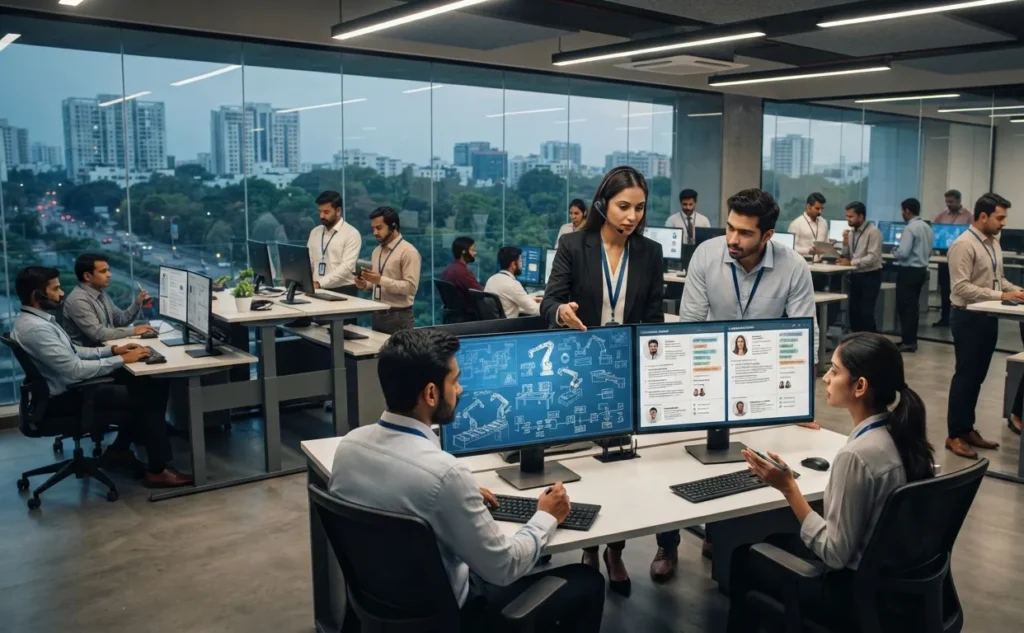
American manufacturing is having a strange moment. Output hit an all-time high of $2.91 trillion in 2024, and the ISM Manufacturing PMI touched 54 in May 2026 — its strongest reading in four years, with new orders, production, and backlogs all expanding at once. By every production metric, the industry is accelerating. Fictiv
By every hiring metric, it’s stalling.
Factory employment has actually shrunk — down more than 70,000 jobs since April 2025, landing at 12.69 million by December, the lowest headcount since March 2022. Meanwhile the Manufacturing Institute and Deloitte project the sector needs 3.8 million new workers by 2033, with 2.8 million of that demand coming from retirements alone — not expansion, just replacement. If the skills and applicant gap isn’t closed, up to 1.9 million of those roles could simply go unfilled. ManufacturingTomorrow + 2
That gap is why offshore manufacturing recruiters have moved from a cost-cutting experiment to a core hiring strategy for US manufacturers in 2026. This guide breaks down who the leading offshore manufacturing recruiting firms actually are, what they cost, how the process works, and the exact checklist to use before you sign with anyone.
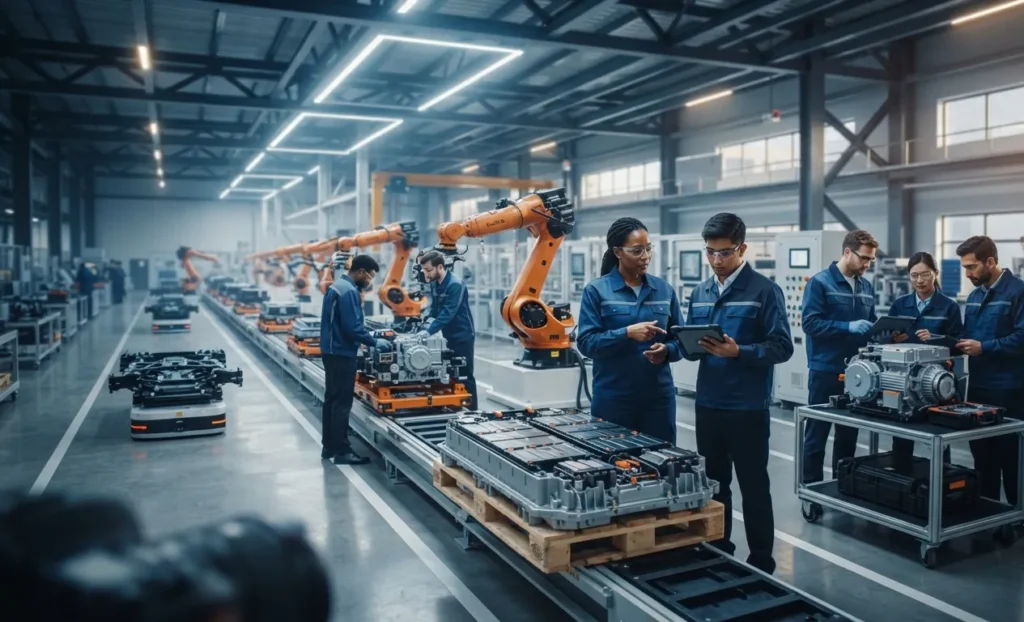
Headline “2 million worker” numbers hide a more specific issue: shortages cluster hardest in states with smaller or highly specialized manufacturing workforces. Montana, Vermont, and New Hampshire post some of the highest job-posting intensity in the country — not because they have the most open roles, but because their talent pools are shallow enough that every vacancy hurts. Large manufacturing states like Texas, California, and Ohio show lower intensity scores simply because their bigger workforces absorb new openings more easily.
Translation: if you’re a specialized manufacturer — aerospace components, semiconductor fabrication, precision tooling — your local labor market may already be tapped out, regardless of what national averages suggest.
There can be plenty of applicants for an open manufacturing role and still be a skills gap, because the mismatch centers on capability, not headcount. Nowhere is this sharper than in semiconductors: the US semiconductor manufacturing workforce dropped from a peak of roughly 401,000 in 2023 to 368,400 by March 2026, even as CHIPS Act-funded fab construction represents the largest planned expansion of domestic chip capacity in decades. The SIA-Oxford Economics study projects the industry needs 115,000 new jobs by 2030 — and roughly 67,000 of those are at real risk of staying unfilled, because higher pay alone doesn’t manufacture skilled process engineers out of thin air. MAU Workforce Solutions + 2
Production and nonsupervisory manufacturing workers crossed $30.10 an hour in April 2026 — the first time this series has ever broken $30 — while average hourly earnings across all manufacturing employees reached $36.68. Rising wages are a good thing for workers, but they compress margins for manufacturers competing for the same shrinking domestic pool. Offshore recruiting doesn’t avoid wage pressure entirely — it redirects your hiring budget toward markets where equivalent technical skill costs meaningfully less. Amtec
This isn’t a “trust us” claim — the data backs it up. Companies using specialist recruitment partners (including offshore RPO) see a 50% reduction in cost-per-hire compared to generalist or volume-based hiring approaches, and referral-driven, relationship-based hiring — a hallmark of specialist recruiters — fills roles 55% faster than traditional sourcing. It’s why RPO engagements in manufacturing are now growing at roughly 18.5% annually — internal HR teams and generalist agencies simply aren’t built for the current market. Talenttraction + 2
Here’s a ranked breakdown of the firms actually delivering offshore manufacturing recruitment at scale — not just running a domestic search practice with a “global” label bolted on.
Headquarters: USA (delivery centers in India)
Best for: Full-cycle offshore RPO for manufacturing, engineering, and industrial operations roles
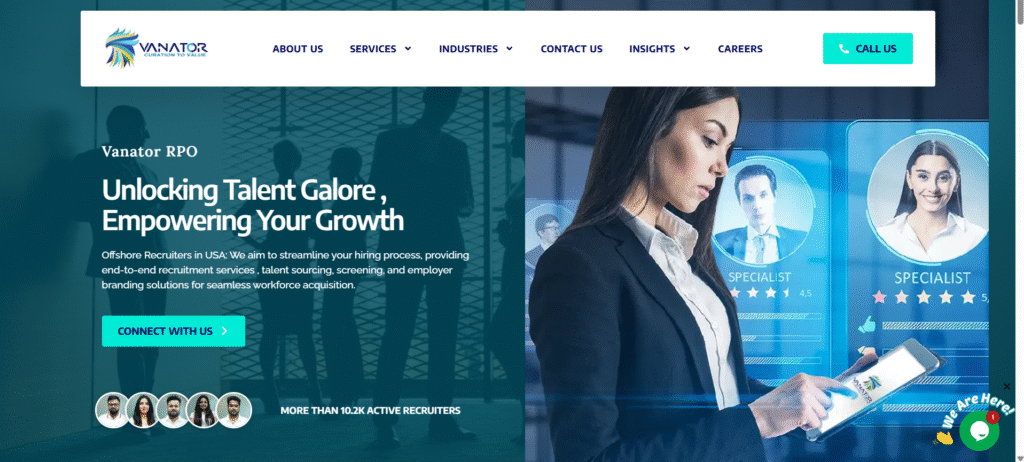
Vanator RPO leads this list for the same reason it leads comparable lists in IT, healthcare, and BFSI: genuine offshore delivery paired with recruitment process outsourcing discipline, not a domestic staffing desk with an international logo. With over 10,200 active recruiters and 1,500+ companies served, Vanator runs technology-enabled sourcing and screening workflows that work inside your ATS, under your brand — covering everything from production engineers and quality managers to supply chain leads and plant operations roles. Their scalability, from single critical hires to bulk plant-ramp hiring, is what makes them the strongest fit for both mid-market manufacturers and larger multi-site operators.
Key strengths: Full-cycle offshore RPO, dedicated account management, scalable from single hires to 100+ seats, background verification included
Contact: (203) 220-2294 | govanator.com
Headquarters: North America-wide (US + Canada coverage)
Best for: Equipment, power, and industrial manufacturing roles
Bemana is one of North America’s most established names in equipment, power, and industrial manufacturing recruitment, backed by more than 35 years of combined recruiting experience. They’ve recruited thousands of candidates across more than 100 companies, and their model leans heavily on long-term client relationships rather than transactional, one-off fills. Talent Hero Media
Key strengths: Deep industrial equipment specialization, national reach across all 50 states
Headquarters: USA (recruiting teams in 24 US markets)
Best for: Engineering-heavy manufacturing roles — aerospace, automotive, defense, semiconductor
CalTek fills more than 18 distinct manufacturing positions — from automation engineers and manufacturing engineers to CAM programmers, tooling engineers, and supply chain engineers — supporting aerospace, automotive, defense, semiconductor, and pharmaceutical manufacturers. They routinely present qualified candidates within a 72-hour window and target roughly a one-week hiring cycle, backed by a 91% retention rate on permanent placements and Forbes 2026 Best of Recruiting recognition. Talent Hero MediaTalent Hero Media
Key strengths: Speed (72-hour candidate presentation), high retention, technical/regulatory depth

Headquarters: Atlanta, GA (global reach)
Best for: High-volume contract staffing across large manufacturing operations
Insight Global supports manufacturers with flexible staffing models, backed by 3,000+ recruiters across 50+ countries, making it a strong option for large-scale, high-volume contract workforce programs rather than niche technical searches. Alpha Apex Group
Key strengths: Massive recruiter bench, global footprint, strong for contract-to-hire at scale

Headquarters: Chicago, IL
Best for: Global RPO and structured high-volume manufacturing hiring
PeopleScout offers global RPO and workforce solutions for manufacturers, backed by 30+ years of experience and their proprietary Affinix talent platform, with documented results including 1,500+ annual contingent hires for enterprise clients. Alpha Apex Group
Key strengths: Enterprise-scale RPO, proprietary sourcing technology, structured high-volume delivery
Headquarters: Hanover, MD
Best for: Technical and skilled-trades manufacturing roles
Aerotek is a US-based staffing and recruiting firm focused on technical, industrial, and engineering talent, supporting manufacturing, aerospace, and construction through contract and direct-placement services. Their sector-focused consultant structure — rather than generalist recruiters — gives them genuine depth in engineering, manufacturing, defense, and scientific placements. Pete & GabiAlliance Recruitment Agency
Key strengths: Skilled trades specialization, contract and direct-hire flexibility
Headquarters: UK and USA
Best for: Offshore RPO with strong workforce-planning analytics
QX Global helps staffing firms transform their operations through future workforce planning and hiring-strategy alignment, alongside core offshore recruitment delivery. Their model leans on data and process automation to reduce the manual burden on internal HR teams. QX Global Group
Key strengths: Workforce planning and analytics layered on top of recruitment delivery
Headquarters: Global, strong US presence
Best for: Vertical-specialist manufacturing search with immigration/compliance support
Alliance structures its practice by industry vertical rather than assigning generalist recruiters across all roles, giving manufacturing clients a consultant who understands scarce skills and compensation benchmarks specific to the sector, alongside full hiring-model flexibility (permanent, contract, RPO). Alliance Recruitment Agency
Key strengths: Vertical specialization, full hiring-model suite, global candidate reach
Headquarters: Milwaukee, WI
Best for: Enterprise-scale, multi-country manufacturing workforce programs
One of the largest global staffing organizations, ManpowerGroup brings deep bench strength and multi-country delivery for manufacturers running large or geographically distributed hiring programs, spanning both skilled trades and technical/professional manufacturing roles.
Key strengths: Global scale, multi-vertical coverage, established enterprise relationships
Headquarters: Zurich, Switzerland (US operations nationwide)
Best for: Enterprise-scale offshore staffing across multiple manufacturing verticals
As one of the world’s largest staffing firms, Adecco brings 60+ country coverage to manufacturing clients needing volume hiring across engineering, quality, operations, and supply chain functions — a strong fit for Fortune 500-scale plant networks.
Key strengths: Global scale, multi-vertical coverage, enterprise client base

Recruiter | Headquarters | Talent Regions | Best For | Starting Cost |
Vanator RPO | USA | India | Full-cycle offshore RPO, engineering & ops | Custom quote |
Bemana | North America | US/Canada | Equipment & industrial manufacturing | Custom quote |
CalTek Staffing | USA | US, 24 markets | Aerospace, automotive, defense, semiconductor | Custom quote |
Insight Global | Atlanta, GA | Global, 50+ countries | High-volume contract staffing | Custom quote |
PeopleScout | Chicago, IL | Global | Enterprise RPO, high-volume hiring | Custom quote |
Aerotek | Hanover, MD | US | Skilled trades, technical roles | Custom quote |
QX Global Group | UK/USA | India, Philippines | Offshore RPO + workforce analytics | Custom quote |
Alliance Recruitment | Global | Multiple | Vertical-specialist search + compliance | Custom quote |
ManpowerGroup | Milwaukee, WI | 60+ countries | Enterprise multi-country programs | Custom quote |
Adecco USA | Zurich | 60+ countries | Enterprise-scale multi-vertical staffing | Custom quote |
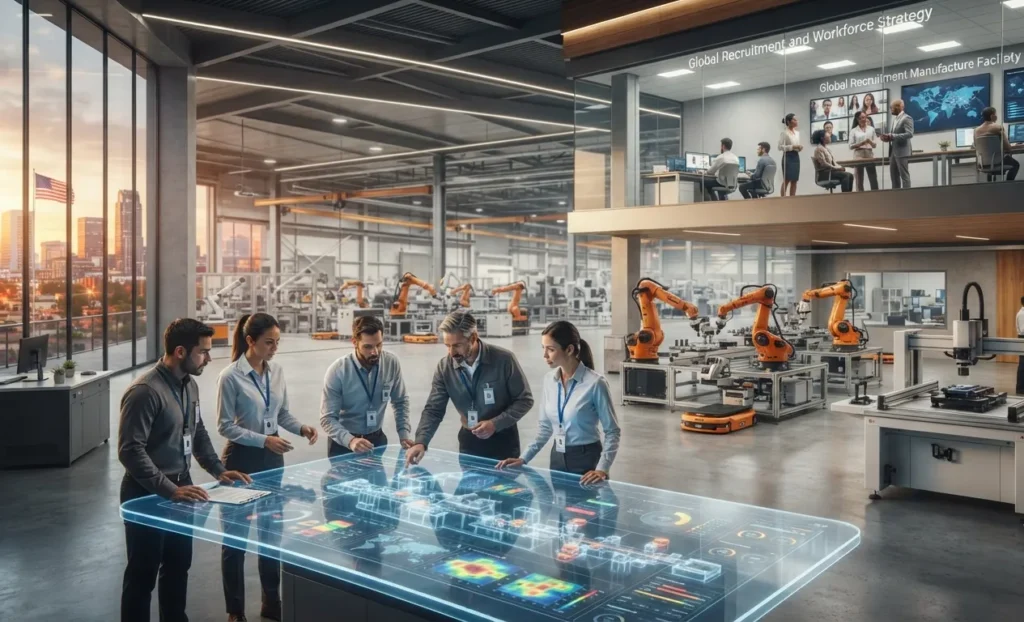
This distinction trips up more manufacturers than any other part of the offshore decision.
Offshore manufacturing recruitment means a recruiter — based onshore, offshore, or both — sources and screens candidates who then join your company directly. You manage them, own their output, and control your IP and processes. This is the model for plant engineers, quality managers, and operations leadership you need embedded in your organization long-term.
Offshore manufacturing outsourcing is a different animal entirely — it means contracting an external company to actually run a production function or project on your behalf. The vendor manages the team, the process, and the deliverables. You define outcomes, not day-to-day execution.
Most of the firms in this guide operate on the recruitment model — you get the talent, you keep control. If a recruiter’s pitch sounds more like “we’ll run this for you” than “we’ll find and place the right people on your team,” you’re being sold outsourcing dressed up as recruitment.
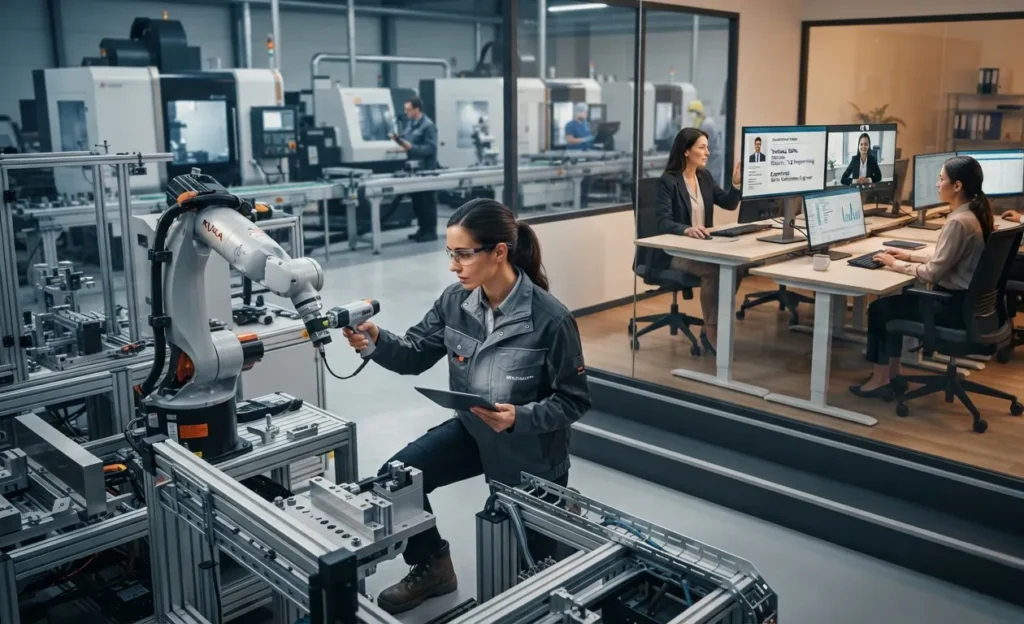
Can they distinguish a CAM programmer from a tooling engineer, or a lean manufacturing lead from a Six Sigma black belt? Ask for placement case studies in your exact vertical — automotive is not aerospace is not food & beverage.
Manufacturing carries real compliance weight — ITAR for defense work, FDA regulations for pharma manufacturing, export control classifications for dual-use technology. A recruiter who doesn’t raise these unprompted during your first call is a red flag, not a blank slate you can train later.
Ask for average time-to-shortlist and time-to-fill on roles similar to yours. Firms like CalTek publish specific numbers — a 72-hour candidate presentation window and a roughly one-week hiring cycle — for good reason. Vague answers here usually mean the data doesn’t flatter them.
Can the firm handle two critical hires this quarter and 50 seats for a new plant ramp-up next year, without the quality curve bending downward? Ask specifically how they staff up for volume surges.
RPO engagements typically price at $3,000–$10,000 per hire on outcome-based deals, or $8,000–$15,000 per month per embedded recruiter on capacity-based deals — and the cheapest structure on paper isn’t always the cheapest in practice. Ask for pricing broken into four buckets: monthly service fee, per-hire fee, one-time implementation, and any pass-through technology costs. eorHQ
Response times, shortlist turnaround, escalation paths — get these in writing, not verbal assurances during the sales call.
A recruiter who fills your role in two weeks but sees the hire leave within 90 days hasn’t actually solved your problem. Ask for 6- and 12-month retention numbers specifically, and be suspicious of any firm that can’t produce them.
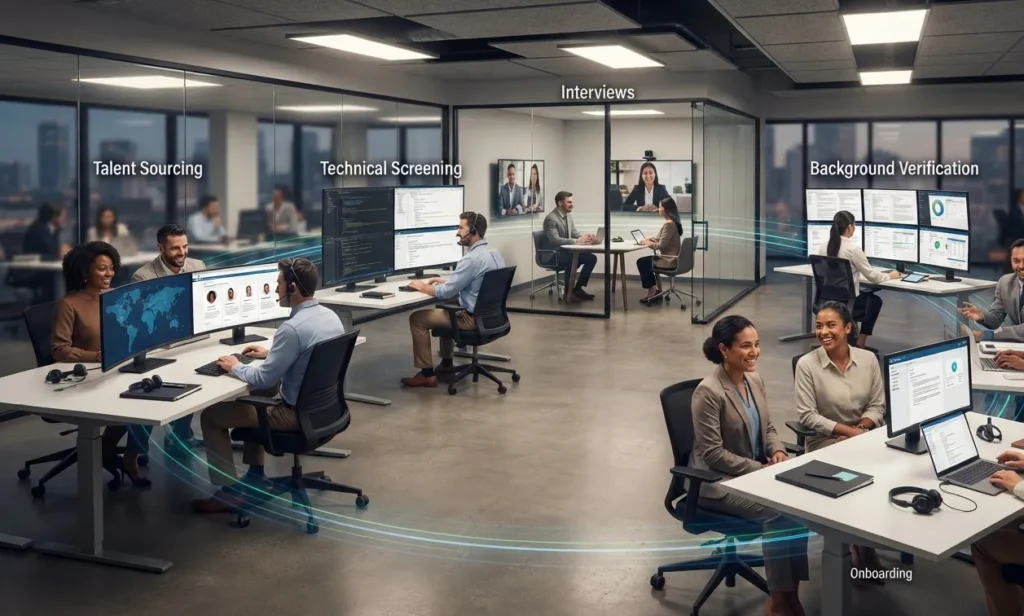
Week 1 — Discovery and requirement scoping. The recruiter works with your plant or engineering leadership to define the role’s technical requirements, compensation band, and cultural/operational fit criteria. This should be a live kickoff conversation, not a job-description email exchange.
Weeks 1–3 — Sourcing and technical screening. Using job boards, proprietary databases, and offshore sourcing networks, the recruiter identifies and pre-screens candidates against your specific technical bar — reviewing hundreds of resumes to surface genuine fits, not keyword matches.
Weeks 2–3 — Shortlist delivery. You receive a curated shortlist, typically 3–5 candidates per role, with skills assessments and interview notes attached. Faster firms deliver this within 5–7 business days of kickoff.
Weeks 3–4 — Client interviews. You run your own technical and cultural interviews. The recruiter manages scheduling logistics across time zones and preps candidates so your interview time isn’t wasted on basic misalignment.
Weeks 4–6 — Offer, onboarding, and retention support. The strongest firms stay engaged past the offer letter — handling background verification, onboarding documentation, and early check-ins that materially affect whether the hire is still there in six months.
Pricing varies by engagement model:
Layered on top of the recruitment fee itself, offshore delivery typically saves 40–60% on total hiring costs compared to fully domestic sourcing and screening — a savings that compounds fastest for manufacturers running sustained, high-volume technical hiring rather than one-off searches. Vanator RPO
IP and design exposure. Manufacturing recruitment routinely touches proprietary designs, specs, and processes during candidate assessment. Mitigate with strong NDAs, recruiters operating in jurisdictions with enforceable IP protections, and controlled access to any technical documentation shared during screening.
Regulatory blind spots. ITAR-controlled defense work, FDA-regulated pharma manufacturing, and export-classified technology all carry rules that most generalist recruiters don’t know exist. Confirm your recruiter can name the specific regulatory framework governing your roles before you engage them — not after.
Communication and time-zone friction. A 9–12 hour gap between US plants and offshore recruiting teams can slow shortlist turnaround if not managed. Establish a defined overlap window and insist on async documentation (shared trackers, recorded updates) rather than relying purely on live calls.
Quality inconsistency at volume. Ramping from 2 hires to 20 can strain a recruiter’s bench. Mitigate by requesting a pilot engagement — fill 2–3 roles first, check retention at 90 days, then scale.

Semiconductor manufacturing. With domestic workforce numbers still down from their 2023 peak even as CHIPS Act fab construction accelerates, semiconductor manufacturers face the sharpest skills-versus-demand gap in the sector. Amtec
Aerospace and defense. Compliance-heavy, highly specialized, and chronically short on cleared engineering talent — a natural fit for recruiters who understand both the technical bar and the regulatory overlay.
Automotive and EV manufacturing. Electrification is creating entirely new role categories — battery engineers, EV powertrain specialists — faster than domestic training pipelines can produce qualified candidates.
Industrial equipment and heavy machinery. Automation and robotics integration roles are growing fastest here, with firms like Bemana and CalTek building deep specialization specifically in this space.
Pharmaceutical and medical device manufacturing. GxP compliance requirements mean recruiters need to understand quality systems and validation processes, not just general manufacturing hiring.

AI-powered technical screening. Leading firms are deploying AI sourcing tools that can screen candidates against highly specific technical criteria — machine specs, certification requirements, software proficiency — far faster than manual resume review.
Hybrid onshore-offshore delivery models. The trend isn’t purely offshore or purely domestic — it’s smart companies keeping plant leadership and safety-critical roles domestic while building broader engineering and support functions through offshore recruitment pipelines.
Rising specialization over generalist volume. As the skills gap deepens in specific sub-sectors (semiconductor, EV, defense), expect more recruiters to narrow their focus rather than broaden it — because specialist partnerships already outperform generalist approaches by a 50% cost-per-hire margin, and that gap is likely to widen, not close. Talenttraction
Retention-first evaluation metrics. Fill rate alone is becoming a weaker signal of recruiter quality. Expect 6- and 12-month retention data to become a standard, expected deliverable rather than something you have to request.
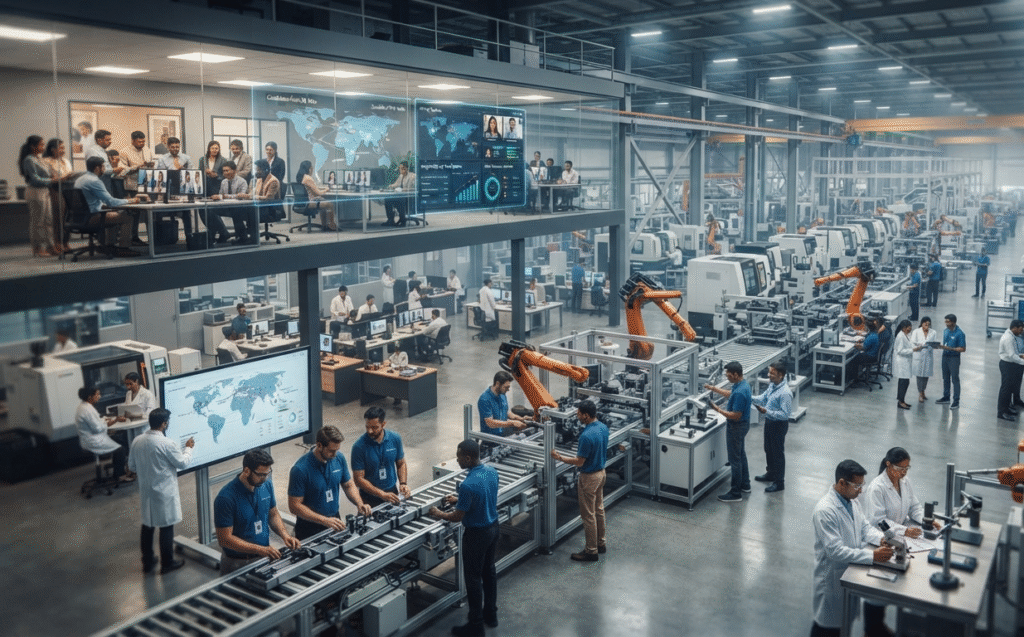
The manufacturers winning the hiring battle in 2026 aren’t the ones with the biggest HR teams — they’re the ones who recognized early that the 1.9 million-worker gap isn’t solvable through domestic sourcing alone, and built offshore recruiting relationships before the shortage forced their hand.
Whether you’re trying to fill three critical engineering roles at a single plant or building an offshore-supported hiring pipeline across a multi-site operation, the right recruiting partner is the difference between chronically understaffed production lines and a stable, scalable talent pipeline.
If you’re ready to explore offshore manufacturing recruitment for your organization, Vanator RPO offers a free consultation to assess your hiring needs and map out a tailored offshore recruitment strategy — backed by 10,200+ active recruiters and 1,500+ companies served.
Ready to close your manufacturing talent gap? Contact Vanator RPO today or call (203) 220-2294 to get started.
An offshore manufacturing recruiter is a firm that sources, screens, and places manufacturing professionals — engineers, quality managers, operations leaders, technical specialists — using global talent networks, while the hired candidates typically join and report directly to the US-based manufacturer.
Offshore recruitment delivery typically cuts total hiring costs by 40–60% compared to fully domestic sourcing and screening, with the largest savings compounding for manufacturers running sustained, high-volume technical hiring.
Yes. Offshore recruitment is standard and legal practice for US manufacturers, though roles touching ITAR-controlled defense work or export-classified technology carry additional compliance requirements that any qualified recruiter should proactively flag.
Most roles fill within 4–8 weeks from kickoff to start date, though top firms deliver initial shortlists in as little as 5–7 business days. Highly specialized or executive-level roles can take longer.
Recruitment places a candidate who joins your company and reports to you — you retain control of the work and your IP. Outsourcing hands an entire function or project to a vendor who manages the team and process independently.
Manufacturing engineers, quality engineers, automation and controls engineers, supply chain specialists, CAM programmers, tooling engineers, process engineers, and plant operations managers are among the most commonly sourced roles.
The crossover point is roughly 15–25 hires per year — below that, contingency's lower overhead usually costs less; above it, RPO's economies of scale typically win on cost-per-hire.
ITAR restrictions on defense-related roles, export control classifications for dual-use technology, and FDA quality-system requirements for pharmaceutical or medical device manufacturing are the most common blind spots for recruiters without sector-specific experience.
Reputable firms use strong NDAs, restrict access to proprietary technical documentation during screening, and operate within jurisdictions that offer enforceable IP protections — this should be confirmed before any technical materials are shared.
Request case studies in your specific manufacturing vertical, documented average time-to-fill, an itemized pricing breakdown across four cost buckets, a written SLA, and 6- and 12-month retention data — not just headline fill-rate numbers.
































Ready to elevate your customer experience? Don’t settle for ordinary support. Our dedicated consultants are standing by to match your enterprise with the highest-caliber customer service executives in the USA. From virtual assistants to specialized account managers, we have the expertise and talent pool to meet your needs.
Contact our team today to discuss how our tailored customer executive services can transform your support operations. Let us help you hire or outsource the best customer service executives in USA, so you can focus on growing your business with confidence. Together, we will build a world-class customer support team that drives loyalty and success.

Let our expert recruiters bring the right talent your way- connect with us today!
Fill in the form below to book a free consulting session: