
The Best Sales Offshore Recruiters in USA help organizations hire qualified sales professionals faster, reduce recruitment costs, and scale revenue teams. This guide compares leading recruiters, pricing models, hiring strategies, and offshore recruitment solutions for sustainable sales growth in 2026
The Best Sales Offshore Recruiters in USA help organizations hire qualified sales professionals faster, reduce recruitment costs, and scale revenue teams. This guide compares leading recruiters, pricing models, hiring strategies, and offshore recruitment solutions for sustainable sales growth in 2026
The US Sales Hiring Market Is Structurally Broken — Here’s the Data
What an Offshore Sales Recruiter Actually Does (And What It Isn’t)
The 2026 Offshore Sales Talent Map
Best Sales Offshore Recruiters in USA: The 2026 Shortlist
The 7-Point Scorecard for Vetting an Offshore Sales Recruiter
Red Flags That Should End the Conversation
Which Sales Roles Offshore Well (And Which Don’t)
What Changed in 2026: The Screening Bar Moved
Compliance: The Part Everyone Skips

There is an uncomfortable truth sitting inside most US revenue orgs right now: the pipeline problem is not a messaging problem, a tooling problem, or a “we need better enablement” problem. It is a hiring problem. And the companies solving it fastest are the ones working with the Best Sales Offshore Recruiters in USA — partners who can source, vet, and seat a fully-ramped SDR, BDR, or account executive in weeks rather than quarters, at a fraction of the loaded cost of a domestic hire. This guide breaks down who those recruiters are, how to separate the operators from the résumé-forwarders, what the math actually looks like in 2026, and the ten questions buyers ask most before signing.
The 30-second version: US sales roles turn over faster than they can be backfilled, cost-per-hire keeps climbing, and the offshore delivery model now accounts for roughly 66% of all recruitment process outsourcing revenue (Grand View Research). Offshore sales recruiters are no longer a cost hack — they are the default staffing engine for growth-stage GTM teams.

Start with the supply side. The US Bureau of Labor Statistics projects little to no employment growth for wholesale and manufacturing sales representatives between 2025 and 2035 — yet roughly 123,400 openings are expected every single year, almost entirely driven by workers transferring out of the occupation or leaving the workforce (U.S. Bureau of Labor Statistics). Translation: you are not competing for growth headcount. You are competing in a churn treadmill where the same finite pool of sellers keeps rotating between employers.
Now the cost side. SHRM’s benchmarking puts average cost-per-hire at $4,129 with roughly 42 days to fill (SHRM), and that figure excludes the part that actually hurts — the revenue that never got booked while the territory sat empty. For a seller carrying a $1.2M quota, a 90-day vacancy plus a 90-day ramp is a quarter-million-dollar hole before the first discovery call.
Layer on compensation. Median pay for technical and scientific sales reps sits at $104,920\\\\\\\*\\\\\\\*, and sales managers at \\\\\\\*\\\\\\\*$138,000+ (BLS Occupational Outlook Handbook). Add benefits, payroll tax, tooling, and commission accelerators, and a single US SDR seat routinely lands north of $100K fully loaded — one vendor analysis puts the in\\\\\\\-house range at \\\\\\\*\\\\\\\*$102K–$210K versus $30K–$48K offshore** (Remote Growth Partners).
That gap is why the offshore recruiting category exploded. The global RPO market reached $12.8 billion in 2025\\\\\\\*\\\\\\\* and is forecast to hit \\\\\\\*\\\\\\\*$31.5 billion by 2033 at a 12.1% CAGR, with North America holding over 41% of revenue (Grand View Research).

The category gets muddied constantly, so let’s be precise. There are three distinct models, and buying the wrong one is the single most common failure mode.
Offshore sales recruiters / offshore RPO. They run your sales hiring function from an offshore delivery center — sourcing, screening, calibration calls, interview scheduling, offer management. The hire becomes your employee or contractor. You own the ramp, the coaching, the CRM, the quota. This is the model built for companies that want a permanent team, not a rented one. Vanator’s recruiting support and 24/7 sourcing support sit here.
Outsourced SDR agencies. They rent you a pod of sellers on their payroll, working from their playbook, often across multiple clients. Faster to switch on, far less control, and the institutional knowledge leaves when the contract does.
Offshore staffing / EOR firms. They handle employment, payroll, and compliance in-country but typically do lighter-touch recruiting. Excellent for the legal wrapper; thin on sales-specific vetting.
The best partners in 2026 blur these lines deliberately — a serious offshore sales recruiter will run your screening support, handle VMS-driven req management if you’re enterprise, and stay in the loop through the 90-day ramp. If a vendor cannot explain which of the three models they are, that is your answer.

Geography is strategy. Where your recruiter sources from determines accent neutrality, timezone overlap, cultural fluency, and cost.
Region | Best for | Typical monthly cost (fully loaded) | Timezone reality |
Philippines | Inbound SDR, CSM, inside sales, support-led revenue | $1,200–$2,500 | Night-shift for US hours; deep BPO maturity |
India | Outbound SDR, lead research, RevOps, technical pre-sales | $1,000–$2,800 | Overnight shift; largest raw talent pool |
Latin America | AE, mid-market outbound, Spanish-language territories | $2,000–$4,500 | Real-time US overlap; nearshore premium |
Eastern Europe | Enterprise SaaS SDR, EMEA expansion, technical selling | $2,500–$5,000 | EU hours; strong English + technical depth |
South Africa | Cold calling, neutral accent, EMEA/US hybrid coverage | $1,800–$3,200 | Partial US overlap |
Ranges are directional market observations, not quotes — vet against live proposals. Providers like Hire With Near publish LatAm sales benchmarks and Manila Recruitment publishes Philippine ones if you want a second reference point.
A note on method, because “best” lists are usually paid placements: the firms below were selected on sales-specific delivery evidence, offshore delivery infrastructure, and verifiable US client presence. Vanator RPO publishes this article, so treat our own entry as a disclosed interest and pressure-test it exactly as hard as the rest.

Hamden, Connecticut HQ with a Noida delivery center, purpose-built for US staffing and GTM firms. Vanator’s differentiator is round-the-clock sourcing throughput paired with US-hours account management — 10.2K+ recruiters in-network and 1,500+ companies served, per company-reported figures. Strongest fit: agencies and growth-stage companies needing sustained req volume across sales and marketing, finance, and non-IT roles. See case studies.
The category’s heavyweight for multi-country GTM builds. Deep employer-branding capability and genuine global delivery (weareams.com). Enterprise pricing; overkill under ~50 hires/year.
Strong analytics layer and workforce planning maturity for companies treating sales hiring as a forecastable pipeline (cielotalent.com).

When the req is VP Sales or CRO rather than SDR, Korn Ferry’s assessment IP and compensation benchmarking are the differentiator (kornferry.com).

Enormous domestic bench and mature contract infrastructure (roberthalf.com). Less offshore-native than the others here, but the fallback when a role must sit onshore.

Retail, field sales, and distributed territory hiring at volume (peoplescout.com).
Narrow by design: AEs, SDR leaders, and CS for venture-backed software (bettsrecruiting.com). Premium fees, high signal.
A sales-exclusive firm with strong Canadian and US coverage and structured seller assessment, now operating as STA with 7,000+ GTM placements across 1,600+ clients on its own reporting (stagtm.com).
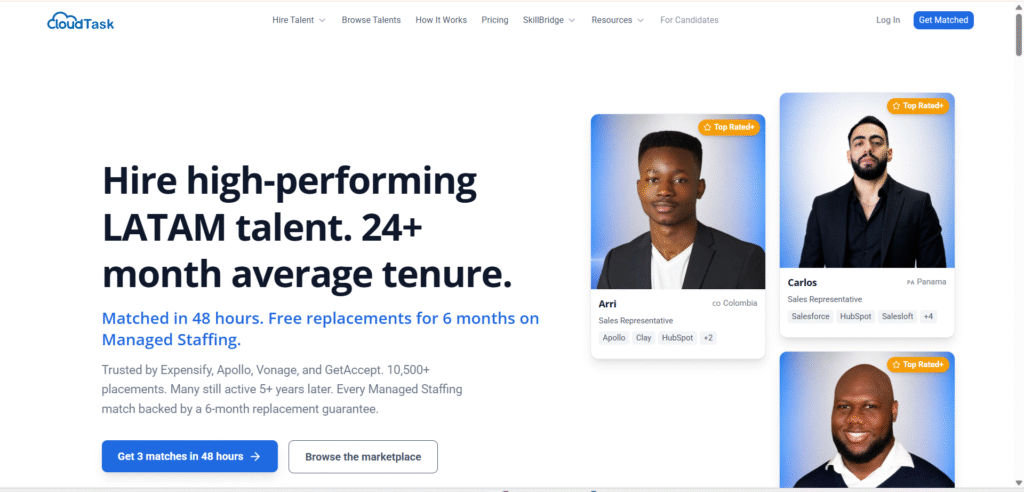
A vetted-marketplace model for buyers who want to interview a curated shortlist directly (cloudtask.com).

The right call when the seller needs to hold a credible architecture conversation (teksystems.com).
For a wider view beyond sales specifically, comparison roundups from Gogloby and Glocal RPO are worth a scan, and our own guides to the best offshore recruitment agencies in USA and top RPO agencies in USA go deeper on non-sales functions.

Score every vendor 1–5. Anything under 25/35 is a pass.


Offshore reliably: SDR and BDR, lead research and list building, inbound qualification, CRM hygiene and RevOps, sales enablement content, customer success for SMB, renewals, and sales support virtual assistants.
Offshore with care: Mid-market AEs — workable with LatAm or Eastern European talent where timezone overlap and cultural fluency are strong, but expect a longer ramp and heavier coaching investment.
Keep onshore: Field sales requiring physical presence, enterprise AEs selling seven-figure deals into relationship-heavy verticals, and regulated selling where licensure is jurisdiction-bound (many insurance and healthcare roles fall here).
The honest framing: offshore is exceptional at the top of the funnel and increasingly credible in the middle. The bottom of the funnel still rewards proximity.

Days 1–30 — Calibrate. Write a scorecard, not a job description: three must-have behaviors, one disqualifier, a target ramp metric. Run a paid pilot req. Sit in on two screening calls yourself.
Days 31–60 — Seat and systematize. Onboard 2–3 sellers, not ten. Document the ICP, objection library, and call framework before you scale, because whatever is undocumented will not survive translation.
Days 61–90 — Measure and expand. Track connect rate, meetings booked, meeting-held rate, and pipeline sourced against your onshore baseline. Expect 70–85% of onshore output by day 90 for SDR work — if you’re below 50%, the problem is almost always enablement, not the hire.
Companies that skip the pilot and go straight to a ten-seat build are the ones who write the “offshore didn’t work for us” post six months later.

Two years ago, the offshore sales recruiting pitch was almost entirely about rate arbitrage. That argument is now table stakes, and the firms winning US logos have shifted to a different one: screening quality that survives AI-inflated candidate supply.
Every recruiter’s inbox is now full of AI-polished résumés, AI-drafted cover letters, and candidates running real-time assistance during video screens. Keyword matching — never a good signal for sellers — is now actively misleading. The practical consequence for buyers is that the vetting step you should scrutinize hardest is the live, unscripted one: a cold-call simulation against an objection the candidate hasn’t seen, a discovery role-play where the interviewer changes the buying criteria mid-call, a written follow-up email produced in ten minutes without tooling.
The second shift is measurement. Serious offshore partners now instrument the funnel the way a RevOps team does — submit-to-interview, interview-to-offer, offer-acceptance, 30/60/90-day retention — and will show you the dashboard rather than describe it. When you’re comparing the Best Sales Offshore Recruiters in USA, ask each finalist to walk you through their last quarter’s numbers on a screen share. The ones who can do it live are running a process; the ones who promise a deck are running a sales call.
Third, timezone expectations hardened. “Overlapping hours” is no longer acceptable for anything customer-facing — buyers now expect full US-shift coverage with US-hours account management, which is exactly why round-the-clock sourcing models have become the default rather than a premium add-on.

Worker classification is the biggest exposure. An offshore seller engaged as a contractor but managed like an employee — fixed hours, your equipment, your direct supervision — creates misclassification risk in several jurisdictions. Either engage through an employer of record, or have your recruiter’s contract clearly establish the relationship. Data handling matters too: your CRM contains customer PII, and India’s DPDP Act, the Philippines’ Data Privacy Act, and GDPR (for any EU-resident prospect data) all have teeth. Require documented security controls, not verbal assurance.

Full disclosure — this is our pitch, and you should weigh it accordingly. Vanator runs offshore recruiting delivery from Noida with US-hours account management out of Connecticut, built specifically around the throughput demands of US staffing firms and growth-stage GTM teams. The practical differences buyers cite: sourcing that runs while you sleep so shortlists land before your standup, sales-specific screening rather than generic keyword matching, and a delivery model that scales req volume up and down without renegotiating the contract. If that’s the shape of your problem, talk to us — and if it isn’t, several firms above are better fits, which is why they’re on the list.

The Best Sales Offshore Recruiters in USA are not the ones with the biggest candidate database. They are the ones who can articulate your sales motion back to you, screen for behavior rather than keywords, publish their retention numbers, and stay engaged through ramp. The cost arbitrage is real and well-documented — but it is the second reason to go offshore. The first is that the domestic pool is churning, not growing, and the companies that build a repeatable offshore sourcing engine in 2026 will be filling territories while their competitors are still reposting the same req.
Start with one pilot role. Score three vendors against the seven-point checklist. Measure at day 90. Then scale what worked.
They are recruitment partners who source, screen, and place sales talent from outside the US — typically India, the Philippines, Latin America, or Eastern Europe — on behalf of American companies. Unlike an outsourced SDR agency, the hire usually joins your team and works your pipeline under your management.
US sales roles run roughly $102K–$210K fully loaded depending on seniority, against roughly $30K–$48K for comparable offshore SDR talent (Remote Growth Partners). Recruiter fees vary by model: contingency search typically runs 15–25% of first-year salary, while RPO subscriptions price per req or per recruiter month and get materially cheaper at volume.
For top-of-funnel work — prospecting, qualification, inbound response — well-trained offshore SDRs commonly reach 70–85% of onshore output within 90 days, and sometimes exceed it on activity volume. For complex enterprise closing, onshore still generally wins. Effectiveness tracks enablement quality far more than geography.
It depends on the motion. Latin America for real-time US timezone overlap and AE-level roles; the Philippines for inbound, CS, and support-led revenue; India for outbound volume, research, and RevOps; Eastern Europe for technical SaaS selling. Match the region to the role, not to the lowest rate card.
A well-run offshore process typically delivers a qualified shortlist in 5–10 business days and a signed offer in 3–4 weeks — against a US benchmark near 42 days to fill (SHRM). Round-the-clock sourcing is the main reason for the compression.
Offshore recruiting finds and vets people who then work for you. Offshore staffing employs the people and rents them to you. Recruiting gives you ownership, culture, and long-term retention; staffing gives you speed and a simpler compliance wrapper. Many buyers use both.
Yes, when structured properly. The risks are worker misclassification, cross-border data protection (GDPR, India's DPDP Act, the Philippines' Data Privacy Act), and tax residency. Engaging through an employer of record or a recruiter with a compliant contracting framework resolves most of it — have counsel review the MSA before signing.
Use the same scorecard you'd use onshore: connect rate, meetings booked, meeting-held rate, opportunity conversion, and pipeline sourced — benchmarked against your existing team, reviewed at day 30, 60, and 90. Do not grade on activity counts alone; dials without meetings held is a coaching signal, not a success metric.
Five questions: What's your submit-to-interview ratio? What's your 90-day retention on sales placements, and on what sample size? Can I watch a recorded screening call? What triggers the replacement guarantee? Who manages my account, in which timezone? Vague answers to any of these are the answer.
Sometimes, but it is not their strength. VP Sales and CRO searches reward deep local network and executive assessment capability — Korn Ferry, Betts, and similar firms are built for it. Offshore recruiters excel at the SDR-through-mid-market-AE band where volume, speed, and repeatability matter most. Many companies run both in parallel.

































Ready to elevate your customer experience? Don’t settle for ordinary support. Our dedicated consultants are standing by to match your enterprise with the highest-caliber customer service executives in the USA. From virtual assistants to specialized account managers, we have the expertise and talent pool to meet your needs.
Contact our team today to discuss how our tailored customer executive services can transform your support operations. Let us help you hire or outsource the best customer service executives in USA, so you can focus on growing your business with confidence. Together, we will build a world-class customer support team that drives loyalty and success.

Let our expert recruiters bring the right talent your way- connect with us today!