
Apply growth hacks for ecommerce sales to reduce checkout friction, recover carts, increase order value, and build loyalty. Learn how AI search, reviews, email and SMS automation, bundles, and retention campaigns improve revenue through measurable experiments across the customer journey
Apply growth hacks for ecommerce sales to reduce checkout friction, recover carts, increase order value, and build loyalty. Learn how AI search, reviews, email and SMS automation, bundles, and retention campaigns improve revenue through measurable experiments across the customer journey

Most ecommerce stores don’t have a traffic problem. They have a leak problem.
Shoppers arrive, browse, add to cart and leave. Customers buy once and never come back. Ad costs keep rising, so every visitor who slips away costs more than the last.
Growth hacking fixes the leaks first, then pours more traffic in. It means running fast, measurable experiments across the whole customer journey and doubling down on what moves revenue.
This guide covers the 15 best growth hacks for generating ecommerce sales in 2026, grouped by funnel stage. Each one explains why it works, how to set it up and which metric proves it. You’ll also get a comparison table, a KPI cheat sheet and a 90-day growth sprint plan.

Baymard Institute’s average documented cart abandonment rate is 70.22%, calculated across 50 studies. Its research also estimates that the average large ecommerce site could gain a 35.26% increase in conversion rate through better checkout design alone, worth an estimated $260 billion in recoverable orders across the US and EU.
Why shoppers abandon (US shoppers, excluding those who were just browsing):
Reason for abandoning | Share of shoppers |
Extra costs too high (shipping, tax, fees) | 40% |
Delivery too slow | 20% |
Didn’t trust the site with card details | 19% |
Site required account creation | 18% |
Checkout too long or complicated | 17% |
Website errors or crashes | 17% |
Unsatisfactory returns policy | 13% |
Total order cost not visible up front | 12% |
Source: Baymard Institute, cart abandonment research.
Almost every reason on that list is fixable without spending another dollar on ads.
Adobe Analytics reports that AI-referred traffic to US retail sites rose 62% year over year in July 2026 and is up 1,219% since October 2024. Those visitors convert 60% better than non-AI traffic, generate 53% more revenue per visit and add 28% more items to their carts. If ChatGPT, Gemini, Perplexity and Google’s AI features can’t read and recommend your products, you’re missing your highest-intent shoppers.
A study by Deloitte and 55, commissioned by Google, found that a 0.1-second improvement in mobile site speed increased retail conversion rates by 8.4%. Small technical gains add up to real revenue.

Ecommerce growth hacking is a test-and-learn approach to increasing online sales that uses fast, low-cost experiments across the full customer journey (traffic, conversion, cart recovery, order value and retention), measures each one against a single revenue metric, and scales only the tactics that prove they work.
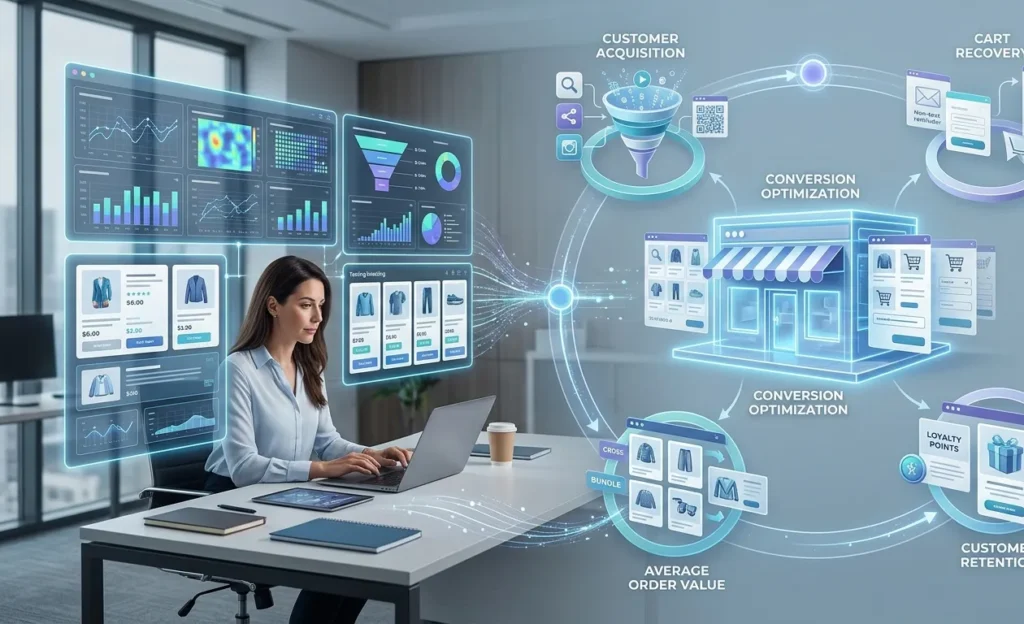
Unlike traditional marketing, which often starts by buying more traffic, growth hacking starts with the funnel you already have. It’s built on five stages:

AI-referred shoppers convert better than any other channel Adobe tracks, so treat AI visibility as a sales channel.
How to do it:
Metric: AI-referred sessions and revenue in GA4 (referrals from chatgpt.com, perplexity.ai and similar sources).
Shoppers search by use case, material, budget and occasion. Create collection and landing pages that match those searches at scale, such as “gifts for runners under $50” or “linen shirts for summer weddings”, with unique copy, filters and FAQs on each.
Metric: Organic sessions and revenue from new landing pages.
Real customers using your product outperform polished studio ads on Meta, TikTok and YouTube Shorts. Ask buyers for short videos in your post-purchase emails, work with micro-creators in your niche, and test UGC hooks before scaling spend.
Metric: Cost per acquisition and return on ad spend by creative.
A “find your perfect match” quiz captures emails and preferences, then recommends products. You get a qualified lead and the data to personalize every follow-up.
Metric: Email capture rate and quiz-to-purchase conversion rate.
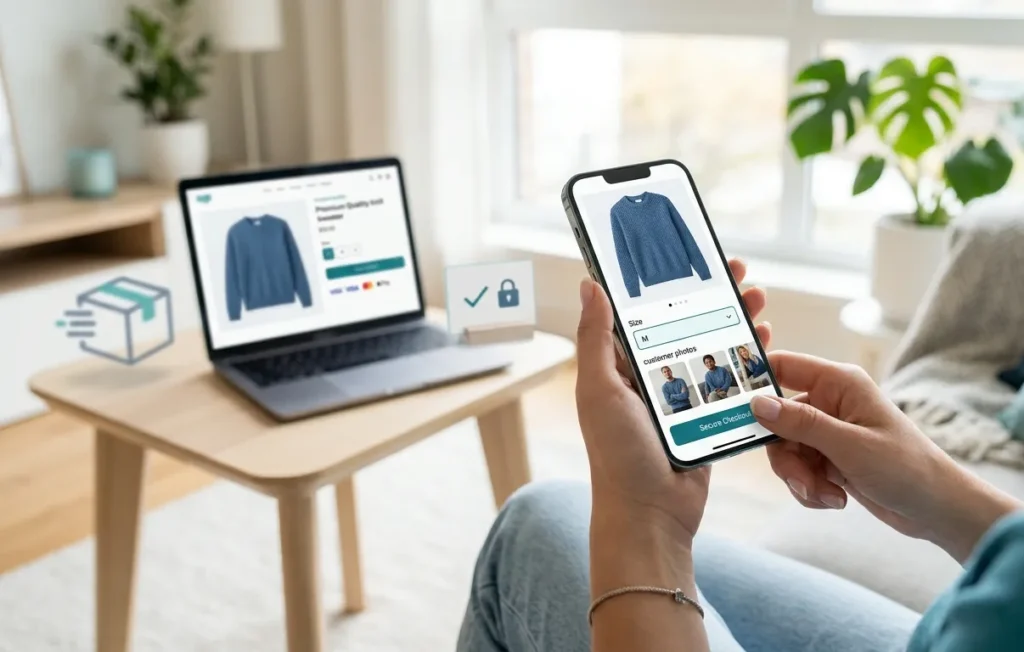
Compress images, lazy-load below-the-fold content, remove unused apps and scripts, and use a fast theme. With an 8.4% conversion lift per 0.1 seconds in the Deloitte study, speed work often pays for itself fastest.
Metric: Largest Contentful Paint (LCP) under 2.5 seconds and mobile conversion rate.
Baymard’s research points straight to the fixes:
Metric: Checkout completion rate.
Research from Northwestern’s Spiegel Research Center found a product with five reviews is 270% more likely to be purchased than one with none. The effect is bigger for higher-priced products (380%), purchase likelihood peaks between 4.0 and 4.7 stars, and a verified buyer badge lifts the odds of purchase by 15%.
How to do it: Send an automated review request 7–14 days after delivery, add photo and video reviews, and display ratings on collection pages, not just product pages.
Metric: Share of products with five or more reviews, and conversion rate on reviewed products.
Extra costs are the number one reason shoppers abandon. A free shipping threshold set 15–30% above your current average order value removes that objection and nudges shoppers to add one more item. Show a progress bar in the cart: “You’re $12 away from free shipping.”
Metric: Average order value and cart abandonment rate.
Questions about sizing, delivery and returns kill sales when nobody answers. Live chat or WhatsApp support during peak hours, backed by an AI chatbot for common questions and a human for buying decisions, catches shoppers at the moment of hesitation.
Metric: Conversion rate of chat users versus non-chat users.

Klaviyo’s 2026 benchmarks, drawn from more than 110,000 customers, put average abandoned cart email revenue per recipient at $6.77 ($13.70 for the top 10% of brands), with SMS at $4.48 ($8.69 for the top 10%).
A proven sequence:
Don’t discount every cart, or you’ll train shoppers to wait for offers.
Metric: Recovered revenue and revenue per recipient.
Shoppers who viewed a product but didn’t add it to cart are your next-warmest audience. Trigger a browse abandonment email, and run retargeting ads with dynamic product catalogs that show the exact products they viewed, capped by frequency so you don’t annoy them.
Metric: Revenue from browse abandonment flows and retargeting return on ad spend.

The moment after checkout is when trust is highest. Offer a complementary product on the thank-you page that customers can add without re-entering payment details. Keep offers relevant, priced below the main item, and limited to one or two.
Metric: Upsell take rate and incremental revenue per order.
Bundles raise order value and make choosing easier. Pair best-sellers with accessories, create starter kits, and show “frequently bought together” on product pages and in the cart.
Metric: Average order value and units per transaction.

Reward repeat purchases, reviews and referrals with points or store credit. Give both the referrer and the friend a reward, and promote the program in your post-purchase emails so it becomes part of the buying experience.
Metric: Repeat purchase rate and revenue from referred customers.
If your products run out (skincare, supplements, pet food, coffee), send a reminder just before customers would need more. For customers who haven’t bought in 60–120 days, send a win-back sequence with new arrivals, social proof and, if needed, a time-limited incentive.
Metric: Customer lifetime value and returning customer revenue share.

Growth hack | Funnel stage | Effort | Cost | Time to impact | Key metric |
AI shopping visibility | Attract | Medium | Low | 1–3 months | AI-referred revenue |
Programmatic SEO pages | Attract | High | Low–medium | 2–6 months | Organic revenue |
UGC and creator ads | Attract | Medium | Medium | 2–6 weeks | ROAS, CPA |
Product-finder quiz | Attract | Medium | Low | 2–4 weeks | Email capture rate |
Mobile speed fixes | Convert | Medium | Low | 1–4 weeks | Mobile conversion rate |
Checkout friction fixes | Convert | Medium | Low | 1–4 weeks | Checkout completion |
First five reviews | Convert | Low | Low | 1–2 months | Reviewed-product conversion |
Free shipping threshold | Convert | Low | Medium | 1–2 weeks | AOV |
Live chat and WhatsApp | Convert | Medium | Medium | 1–2 weeks | Chat conversion rate |
Abandoned cart flow | Recover | Low | Low | 1 week | Recovered revenue |
Browse abandonment and retargeting | Recover | Medium | Medium | 2–4 weeks | Flow revenue, ROAS |
Post-purchase upsells | Expand | Low | Low | 1–2 weeks | Upsell take rate |
Bundles | Expand | Low | Low | 1–2 weeks | AOV |
Loyalty and referrals | Retain | Medium | Medium | 1–3 months | Repeat purchase rate |
Replenishment and win-back | Retain | Low | Low | 2–6 weeks | Customer lifetime value |
Where to start: If you can only do three things this month, launch the abandoned cart flow, fix checkout friction and set a free shipping threshold. They’re low effort, low cost and pay back within weeks.
Metric | Formula | Why it matters |
Conversion rate | Orders ÷ sessions × 100 | Measures how well your store sells |
Average order value (AOV) | Revenue ÷ orders | Shows the impact of bundles, upsells and thresholds |
Cart abandonment rate | 1 − (completed orders ÷ carts created) | Shows checkout friction |
Customer acquisition cost (CAC) | Marketing spend ÷ new customers | Keeps ad spend profitable |
Customer lifetime value (CLV) | AOV × purchase frequency × customer lifespan | Tells you how much you can spend to acquire a customer |
Repeat purchase rate | Customers with 2+ orders ÷ total customers | Measures retention |
Revenue per recipient (RPR) | Email or SMS revenue ÷ recipients | Compares flows and campaigns fairly |
A healthy store aims for CLV at least three times CAC.

Growth hacks that use email and SMS have to follow the rules in your customers’ countries:
Collect clear opt-ins, honor unsubscribes quickly and keep consent records. This is general information, not legal advice.

Most ecommerce owners end up juggling a developer, an ads freelancer, an email agency and a part-time assistant, and nobody owns the full funnel. Vanator Assist brings digital marketing specialists and dedicated virtual assistants into one team, so every growth hack in this guide gets planned, launched, measured and maintained.
Funnel stage | What Vanator Assist handles | Outcome for the owner |
Attract | SEO and AI-search optimization, product page copy, structured data, programmatic landing pages, Meta and Google ads, social media and creator coordination | More qualified shoppers at a lower cost |
Convert | Website design and speed improvements, checkout and product page optimization, review collection, live chat and customer support | More visitors become buyers |
Recover | Abandoned cart, browse abandonment and retargeting campaigns across email, SMS and ads | Lost carts turn into recovered revenue |
Expand | Bundle and upsell setup, offer testing and merchandising support | Higher average order value |
Retain | Email marketing, loyalty and referral programs, win-back and replenishment flows | More repeat customers |
Operations | Order data entry, catalog updates, customer emails, reporting and dashboards | The owner gets time back to grow |
Vanator Assist has its head office at 2260 Whitney Ave, Hamden, Connecticut, delivers from its operations center in Noida, India, and offers 24/7 support for clients across the US, UK, Canada, Australia and the UAE.



AI is moving from recommending products to buying them. AI shopping agents can now compare products, check availability and complete purchases for shoppers. The stores that win will have machine-readable product data, clear pricing and stock, strong reviews and fast checkouts, which are exactly the foundations covered in this guide.

The best growth hacks for generating ecommerce sales aren’t secret tricks. They’re a system: attract the right shoppers, remove friction, recover lost carts, raise order value and keep customers coming back. Start with the fixes that pay back fastest, measure everything, and scale what works.
If you want one team to run that system, from SEO, ads and email to checkout fixes and day-to-day store support, Vanator Assist can help.
Talk to Vanator Assist. Book a free consultation and get a free website SEO and design audit. Call +1 (203) 220-2294, email info@vanatorassistme.com or visit vanatorassistme.com.
Launch an abandoned cart email and SMS flow, fix checkout friction and set a free shipping threshold. These recover sales you’re already losing and usually pay back within weeks.
Optimizing products for AI shopping assistants, fixing mobile speed, removing checkout friction, collecting reviews, running abandoned cart flows, adding post-purchase upsells and launching loyalty and win-back programs.
The average documented rate is about 70%, according to Baymard Institute. Anything below that is better than average, and checkout improvements can lift conversion rates by around 35% for large stores.
Send a reminder email 2–4 hours after abandonment, an SMS after 24 hours and a final message after 48 hours. Show the cart contents and reviews, and reserve discounts for high-value carts.
Set a free shipping threshold above your current AOV, offer bundles, show “frequently bought together” items and add one-click post-purchase upsells.
Yes. Spiegel Research Center found products with five reviews are 270% more likely to be purchased than products with none, with an even bigger effect on higher-priced items.
Write detailed, question-answering product descriptions, add Product, Offer, Review and FAQ structured data, keep prices and stock visible, and publish buying guides and comparison pages.
Yes. A Deloitte study commissioned by Google found that a 0.1-second improvement in mobile site speed increased retail conversion rates by 8.4%.
Yes, with consent. Klaviyo benchmarks show abandoned cart SMS earning $4.48 per recipient on average. Collect clear opt-ins and follow local rules such as the TCPA in the US.
Vanator Assist combines digital marketing specialists and dedicated virtual assistants to run SEO, ads, email and SMS flows, website and checkout improvements, customer support and reporting, starting with a free consultation and website audit.






























Ready to elevate your customer experience? Don’t settle for ordinary support. Our dedicated consultants are standing by to match your enterprise with the highest-caliber customer service executives in the USA. From virtual assistants to specialized account managers, we have the expertise and talent pool to meet your needs.
Contact our team today to discuss how our tailored customer executive services can transform your support operations. Let us help you hire or outsource the best customer service executives in USA, so you can focus on growing your business with confidence. Together, we will build a world-class customer support team that drives loyalty and success.

Let our expert recruiters bring the right talent your way- connect with us today!