
The Best Offshore Biotechnology Recruiters in 2026 help life sciences organizations source specialized scientific, clinical, regulatory, and manufacturing talent while reducing recruitment costs. The guide compares providers, compliance requirements, pricing models, hiring opportunities, and strategies for selecting the right offshore partner
The Best Offshore Biotechnology Recruiters in 2026 help life sciences organizations source specialized scientific, clinical, regulatory, and manufacturing talent while reducing recruitment costs. The guide compares providers, compliance requirements, pricing models, hiring opportunities, and strategies for selecting the right offshore partner
The Biotech Talent Paradox, Explained
What Is an Offshore Biotechnology Recruiter?
The Compliance Layer Nobody Budgets For
Best Offshore Biotechnology Recruiters in 2026
What Offshore Biotechnology Talent Costs in 2026
Where Offshore Recruiting Works Best in Biotech
The 8-Point Evaluation Framework
The 90-Day Implementation Blueprint
Where Offshore Biotech Recruiting Genuinely Fails

Identifying the best offshore biotechnology recruiters in 2026 has become urgent for an industry living inside a genuine paradox — biopharma laid off an estimated 42,700 employees in 2025, a 16% year-on-year rise, yet life sciences unemployment in Massachusetts sits below 2.0% and specialised scientific roles routinely take more than 90 days to fill.
Both narratives are true; they simply apply to different roles. Cell and gene therapy manufacturing shows demand exceeding supply by roughly 3:1, CMC regulatory affairs specialists are placed within 30 days of becoming available, and AI-driven drug discovery talent is being bid away by Big Tech and quantitative finance rather than by rival biotechs (KiTalent, 2026).
Meanwhile, offshore delivery in India and Eastern Europe can reduce operational costs by up to 60% versus Western economies (ProRelix Research, 2026), and RPO engagements typically cost 60–75% less than traditional contingency staffing (Orion Talent, 2026).
The short version Layoffs and shortages are hitting different roles. Cuts landed in commercial, administrative, and post-merger redundant functions. Shortages sit in specialised technical and regulatory functions. The people released are largely not the people needed. Compliance is heavier here than in any other vertical. GxP training obligations and 21 CFR Part 11 attribution extend to contractors — shared logins fail audit immediately. Model the cost of the vacancy, not just the search. A delayed CMC regulatory hire that pushes an IND filing by a quarter costs far more than any placement fee. |

Read the headlines and biotech looks like a shrinking industry. Read the requisition data and it looks like a talent famine. Both readings are correct, and understanding why is the foundation of any sensible offshore recruiting strategy.
The layoff picture is real but narrowing. Biopharma layoffs rose 16% year-on-year in 2025, affecting an estimated 42,700 employees. In the first four months of 2026, however, the number of companies announcing cuts dropped sharply — from 95 firms to 40 — even though the headcount affected stayed nearly flat at roughly 7,400 (Xtalks, 2026). Fewer companies are cutting; those that do are cutting deeper. That is consolidation, not collapse
Massachusetts life sciences unemployment Below 2.0% While the US life science industry added roughly 100,000 new jobs between late 2024 and mid-2026. Specialised scientific roles still take over 90 days to fill through conventional methods. (KiTalent, 2026) |
The three acute shortage disciplines
Discipline | Supply–demand condition | Why it is scarce |
Cell & gene therapy manufacturing | Demand exceeds supply ~3:1 | GMP experience with viral vectors and autologous processes takes years to build |
CMC regulatory affairs | Placed within 30 days of availability | Requires both technical depth and agency-facing judgment |
AI / ML drug discovery | Candidates drawn from Big Tech and quant finance | Biotech competes on mission, not compensation |
The resolution to the paradox is simple: layoffs concentrated in commercial, general administrative, and redundant post-merger functions. Shortages concentrated in specialised technical and regulatory functions. The people let go are largely not the people needed.
That gap is what an offshore biotechnology recruiter exists to close — by expanding the search radius beyond a handful of overheated domestic clusters.

An offshore biotechnology recruiter is a specialised recruitment professional — typically based in India, Eastern Europe, or the Philippines — who sources, screens, and places scientific, clinical, regulatory, and manufacturing talent on behalf of biotech, pharmaceutical, CRO, and medical device organisations in the US, UK, EU, and Canada.
The domain knowledge required here is unusually high. A competent biotech recruiter can distinguish a candidate who has run a Phase II trial from one who supported it, knows why upstream and downstream bioprocessing are different skill sets, recognises what a QP certification means in an EU context, and understands that “GMP experience” spans an enormous range of actual capability.
Band | Representative roles |
Research & discovery | Research associates, scientists, computational biologists, bioinformaticians, assay development specialists |
Clinical development | Clinical research associates (CRAs), clinical data managers, biostatisticians, medical writers, trial managers |
Regulatory & quality | Regulatory affairs specialists, CMC writers, QA/QC analysts, validation engineers, compliance managers |
Manufacturing & CMC | Process development scientists, MSAT engineers, GMP manufacturing associates, supply chain specialists |
India in particular offers a deep bench here — a vast network of English-speaking, globally trained clinicians, scientists, and data managers supported by globally certified laboratories and accredited hospital networks, with data quality and regulatory compliance standards equivalent to Western clinical research organisations.

This is where offshore biotech recruiting differs fundamentally from offshore recruiting in any other vertical, and where most first-time engagements get into trouble. If your offshore personnel will touch GxP systems, regulated data, or trial documentation, the following are not optional.
The FDA expects all GxP data — including training records — to meet ALCOA+ principles: Attributable, Legible, Contemporaneous, Original, and Accurate, plus Complete, Consistent, Enduring, and Available (Datastat, 2026).
Critically, organisations must ensure external personnel accessing GxP areas receive appropriate training, which means extending your learning management system to non-employees while maintaining security and generating compliant records of their qualifications (eLeaP, 2026).
AUDIT-CRITICAL Every training record must clearly identify who performed the action. That requires unique user accounts with distinct login credentials linked to each individual’s identity — no shared logins, no generic “offshore team” accounts. This is a common and expensive shortcut in offshore engagements, and it fails audit immediately. Training depth must also match role responsibility (GxP Training, 2026). |
Requirement | What it looks like in an offshore engagement |
Unique user attribution | Named accounts per offshore individual; no shared credentials, ever |
Role-appropriate GxP training | Documented curriculum matched to each person’s actual system access |
Training record integrity | ALCOA+ compliant records, retained per your SOP, audit-retrievable |
Contractor differentiation | LMS distinguishes employee vs. contractor with distinct retention rules |
Access control | Least-privilege access to validated systems; documented and periodically reviewed |
Vendor qualification | Written quality agreement; offshore provider treated as a qualified vendor |
The distinction that matters for recruiting An offshore recruiter sourcing and screening candidates is performing business development, not GxP-regulated work — the same as any corporate talent acquisition function. Compliance obligations attach when offshore personnel access regulated systems, trial data, or documentation. Recruiting itself sits outside that boundary; the roles you are recruiting into sit firmly inside it. Any offshore partner who cannot articulate this distinction clearly in a first conversation does not understand the industry well enough to recruit for it.
|
Ten providers, assessed on scientific domain depth, compliance maturity, delivery model, and whether they genuinely deliver offshore.
Best overall for life sciences recruitment process outsourcing
Headquarters USA Delivery India Model Full-cycle RPO + dedicated recruiters Offshore delivery Yes |
Vanator RPO leads this list because it operates as a genuine recruitment process outsourcing partner across Healthcare Clinical & Life Sciences rather than a CRO renting you scientists. Recruiters work under your brand, in your ATS, following your process — which matters enormously in an industry where employer brand and scientific credibility determine whether a senior candidate takes your call.
With 10,200+ active recruiters and 1,500+ companies served, Vanator covers research, clinical, regulatory, and manufacturing bands, with structured multi-stage screening, credential verification, interview coordination, background checks, and offer management supported by data-driven reporting. Coverage extends internationally through offshore recruiting in Australia and Canada.
Standout: Places scientific professionals into your organisation as employees rather than renting hourly capacity — so retention, institutional knowledge, and GxP training investment stay with you.
Contact: (203) 220-2294 · govanator.com

Best for US biotech executive search
Headquarters Boston, MA Delivery US + global Model Executive search and staffing Offshore delivery No |
Sci.bio focuses exclusively on biotech and pharma, with strong presence in the Boston–Cambridge cluster and deep networks in scientific leadership (Sci.bio, 2026). Best when the role is VP Research, CSO, or Head of CMC and the hire depends on trusted peer introductions rather than volume outreach.
Best for: Senior scientific and executive leadership hires.

Best for global biopharmaceutical volume hiring
Headquarters Quincy, MA Delivery Global Model Contingency and RPO Offshore delivery Partial |
PharmaLogics specialises in biopharmaceutical recruiting at scale, with capacity for multi-role programme hiring across clinical and manufacturing functions (PharmaLogics, 2026).
Best for: Companies scaling a function quickly — building out a clinical operations team ahead of a pivotal trial.

Best for contract and FSP staffing
Headquarters US / UK Delivery Global Model Contract, FSP, permanent Offshore delivery Partial |
Planet Pharma provides life sciences recruitment across contract, functional service provider, and permanent models, useful when trial timelines demand flexible headcount (Planet Pharma, 2026).
Best for: Variable-duration clinical staffing tied to trial phases.

Best India-based biotech and pharma recruitment
Headquarters India Delivery India Model Recruitment and staffing Offshore delivery Yes |
ALP Consulting runs dedicated biotech and pharma recruitment practices from India, with direct access to the domestic scientific talent pool and established processes for supporting Western sponsors (ALP Consulting, 2026).
Best for: Organisations building India-based R&D or clinical operations capability.
Best for measurable RPO economics
Headquarters Cary, NC Delivery Global Model Pharma and biotech RPO Offshore delivery Partial |
Orion publishes concrete RPO performance data: engagements typically cost 60–75% less than traditional staffing firms, with an average 15-day reduction in time-to-fill and a 35% reduction in recruiting costs (Orion Talent, 2026).
Best for: Firms that need a defensible business case before committing to RPO.

Best for hard-to-fill technical roles
Headquarters Cleveland, OH Delivery US Model Specialised search Offshore delivery No |
Hunter focuses on critical life science roles that conventional pipelines miss, publishing regular analysis of which functions are hardest to fill (Hunter Recruiting, 2026).
Best for: Single high-difficulty searches — validation engineers, CMC regulatory, cell therapy MSAT.

Best for Boston cluster market intelligence
Headquarters Boston, MA Delivery US Model Specialised biotech recruiting Offshore delivery No |
KiTalent publishes granular analysis of Boston-area supply-demand ratios by discipline, which makes them useful as much for market intelligence as for placement (KiTalent, 2026).
Best for: Companies hiring into Boston–Cambridge who need realistic expectations on timeline and compensation.
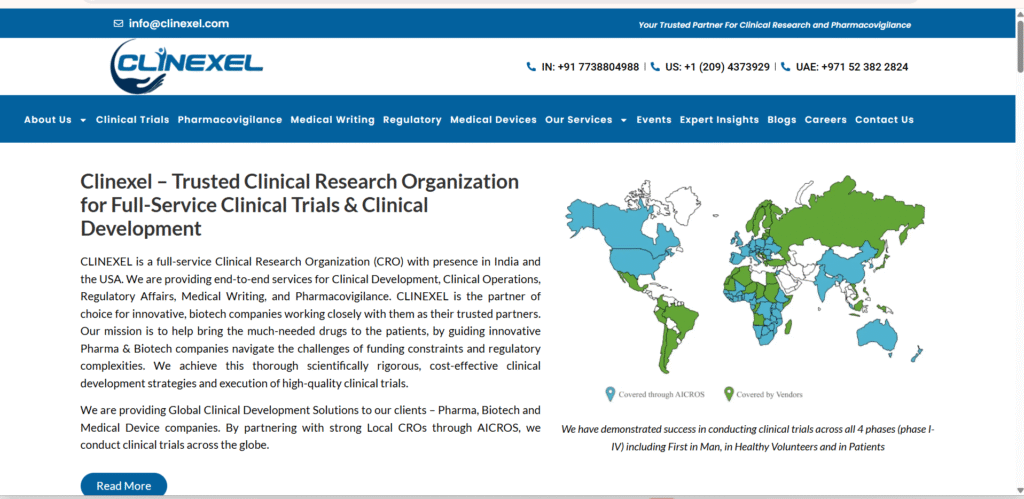
Best for clinical trial delivery staffing
Headquarters India Delivery India Model CRO and clinical staffing Offshore delivery Yes |
India’s CRO ecosystem provides trained clinical research staff supported by accredited hospital networks and certified laboratories, at operational costs up to 60% below Western economies (Clinexel, 2026).
Best for: Sponsors running trials with India-based sites or seeking clinical data management capacity.
Best for market-timing guidance
Headquarters US Delivery US Model Talent advisory and search Offshore delivery No |
Vector publishes candid assessments of where the biotech hiring market actually stands rather than where vendors would like it to be (Vector, 2026).
Best for: Leadership teams deciding whether to hire now or wait on funding.

The “offshore delivery” column separates providers who can genuinely lower your cost base from domestic search firms with global branding.
Provider | Model | Delivery | Cost profile | Offshore | Best for |
Vanator RPO | Full-cycle RPO | India | Custom / dedicated | Yes | Life sciences RPO, all four bands |
Sci.bio | Executive search | US + global | Retained / premium | No | Scientific leadership hires |
PharmaLogics | Contingency + RPO | Global | 18–25% of salary | Partial | Volume biopharma hiring |
Planet Pharma | Contract / FSP | Global | Hourly + margin | Partial | Trial-linked flexible staffing |
ALP Consulting | Recruitment | India | Low | Yes | India R&D and clinical builds |
Orion Talent | Pharma RPO | Global | 60–75% below staffing | Partial | Defensible RPO business case |
Hunter Recruiting | Specialised search | US | Contingency | No | Single hard-to-fill roles |
KiTalent | Biotech recruiting | US | Contingency | No | Boston cluster intelligence |
India CRO network | CRO + clinical staffing | India | Up to 60% savings | Yes | Clinical delivery, data management |
Vector TA | Advisory + search | US | Varies | No | Hire-now-or-wait decisions |

Cost structures in this vertical split into three distinct models, and conflating them produces bad budgets.
Model | Economics | Notes |
Offshore operational delivery | Up to 60% below Western | Driven by labour and facility costs plus faster patient recruitment and data collection cycles |
RPO engagement | 60–75% below traditional staffing | Average 15-day reduction in time-to-fill; 35% reduction in recruiting cost per hire |
Contingency search | 18–25% of first-year salary | On a $160,000 senior scientist: $28,800–$40,000 for a single hire |
|
Hiring volume (annual) |
Most economical model |
Reasoning |
|
1–3 specialised hires |
Contingency search |
RPO onboarding and GxP setup overhead does not amortise |
|
4–15 hires |
Dedicated offshore recruiter |
Effective cost per hire falls below contingency by hire #4–5 |
|
15+ hires |
Full RPO engagement |
Time-to-fill and cost-per-hire advantages compound |
The factor most firms omit A 90-day vacancy in a critical path role has downstream cost far exceeding the recruiting fee. A delayed CMC regulatory hire that pushes an IND filing by a quarter costs vastly more than any placement fee. When evaluating offshore recruiting economics, model the cost of the vacancy — not just the cost of the search. |



Phase | Focus | What must be true before you advance |
Days 1–21 | Scientific and compliance immersion | Recruiter understands your platform, pipeline stage and therapeutic focus. Vendor qualification complete, quality agreement signed, named ATS accounts provisioned — no shared credentials. |
Days 22–45 | Calibration on a known role | Every sourced profile reviewed together for the first fortnight. By week four their shortlists should match what you would have selected yourself. |
Days 46–70 | Scope expansion with review layers | Requisitions added across bands. Submit-to-interview and interview-to-offer ratios tracked rather than raw activity volume. Weekly pipeline review running. |
Days 71–90 | Measure against baseline | Time-to-fill, cost-per-hire and offer-acceptance rate compared to pre-offshore numbers. Beating the 90-day conventional average meaningfully means it is working. |

Honest limitations matter more than a sales pitch.


The best offshore biotechnology recruiters in 2026 are not the ones with the largest databases or the lowest hourly rates. They are the ones who can hold a technical conversation with your VP of Research without losing credibility, who raise GxP and Part 11 obligations before you have to, who verify international scientific credentials properly, and who will prove the model on a 90-day pilot rather than demanding a year.
The structural case is settled. An industry with sub-2% specialist unemployment, 90-plus-day fill times, a 3:1 shortage in cell and gene therapy manufacturing, and computational talent being bid away by better-paying sectors cannot solve its staffing problem inside a handful of overheated domestic clusters. Offshore recruiting expands the search radius — and in a regulated industry, doing it with a partner who takes compliance seriously is the whole game.
WORK WITH VANATOR RPO Vanator RPO offers a no-cost consultation covering Healthcare Clinical & Life Sciences recruitment across the US, Canada, and Australia — with an RPO model that places scientific professionals into your organisation rather than renting them by the hour. govanator.com · (203) 220-2294 |
An offshore biotechnology recruiter sources, screens, and places scientific, clinical, regulatory, and manufacturing talent for biotech, pharma, CRO, and medical device organisations. Their work spans research and discovery roles (scientists, bioinformaticians), clinical development (CRAs, data managers, biostatisticians), regulatory and quality (regulatory affairs, CMC writers, QA/QC), and manufacturing (process development, MSAT, GMP associates). Unlike a generalist recruiter, they can assess GMP depth, verify international scientific credentials, and screen for therapeutic area experience. (Vanator RPO)
Because the layoffs and the shortage affect different roles. Biopharma layoffs rose 16% year-on-year in 2025, affecting roughly 42,700 employees — but those cuts concentrated in commercial, administrative, and post-merger redundant functions. Meanwhile Massachusetts life sciences unemployment sits below 2.0%, specialised scientific roles take over 90 days to fill, and cell and gene therapy manufacturing shows demand exceeding supply by about 3:1. The people released are largely not the people needed. (KiTalent, 2026)
Three models apply. Offshore operational delivery in India runs up to 60% below Western equivalents. RPO engagements typically cost 60–75% less than traditional staffing firms, with an average 15-day reduction in time-to-fill and 35% reduction in recruiting cost. Traditional contingency search runs 18–25% of first-year salary — $28,800–$40,000 on a $160,000 senior scientist. Above roughly four specialised hires per year, a dedicated offshore recruiter beats contingency economics. (Orion Talent, 2026)
The recruiters themselves generally do not, because sourcing and screening candidates is business development rather than GxP-regulated work. However, if any offshore personnel access GxP systems, regulated data, or trial documentation, they must receive role-appropriate GxP and 21 CFR Part 11 training, with records meeting ALCOA+ principles and unique user attribution — no shared logins. Your LMS must differentiate contractor records from employee records. (eLeaP, 2026)
Best suited to offshore delivery: clinical data management, biostatistics, regulatory and CMC writing, bioinformatics and computational biology, and pharmacovigilance. Best suited to offshore recruiting (where the hire works onshore): essentially all scientific and clinical roles, since sourcing is location-independent. Poorly suited to offshore delivery: wet-lab research, GMP manufacturing, and any role requiring physical presence.
Three stand out. Cell and gene therapy manufacturing, where demand exceeds supply roughly 3:1 because GMP experience with viral vectors and autologous processes takes years to accumulate. CMC regulatory affairs, where available specialists are placed within 30 days. And AI/ML drug discovery, where candidates come from Big Tech and quantitative finance and biotech must compete on mission rather than compensation. (KiTalent, 2026)
Yes, and the infrastructure argument is stronger than the cost argument. India hosts a large network of English-speaking, globally trained clinicians, scientists, and data managers, supported by globally certified laboratories and accredited hospital networks, with data quality and regulatory compliance standards comparable to Western clinical research organisations. Operational costs run up to 60% below Western economies, and patient recruitment cycles are frequently faster. (ProRelix Research, 2026)
Expect first qualified shortlists within 3–4 weeks of onboarding completion, and first placements within 8–12 weeks. Context matters: specialised scientific roles average over 90 days to fill through conventional methods, so beating that meaningfully by day 90 indicates the engagement is working. Meaningful quality improvement typically appears around day 45–60, after the calibration period. Judging the engagement at day 21 will produce a false negative.
Recruiting itself involves limited IP exposure — job descriptions and candidate data rather than research data. Nonetheless: execute NDAs covering both company and candidate information, provision named ATS accounts with role-based access rather than shared logins, restrict access to unpublished pipeline detail until a candidate is under NDA, use your own systems rather than the vendor’s, treat the provider as a qualified vendor with a written quality agreement, and audit access logs quarterly. If offshore personnel will touch regulated systems, the full GxP and Part 11 control set applies.
Evaluate on eight criteria: scientific domain fluency (test it with a technical question), unprompted compliance literacy on GxP and 21 CFR Part 11, a real credential verification process for international qualifications, therapeutic area depth matching your pipeline, recruiter-to-requisition ratio under 8–10, named recruiter continuity rather than pool rotation, a written communication SLA with defined overlap hours, and 12-month retention data rather than fill-rate vanity metrics. Insist on a 90-day paid pilot — scientific recruiting cycles are too long for 30 days to prove anything. Explore Vanator RPO’s life sciences recruiting to see how these map to a live engagement.

































Ready to elevate your customer experience? Don’t settle for ordinary support. Our dedicated consultants are standing by to match your enterprise with the highest-caliber customer service executives in the USA. From virtual assistants to specialized account managers, we have the expertise and talent pool to meet your needs.
Contact our team today to discuss how our tailored customer executive services can transform your support operations. Let us help you hire or outsource the best customer service executives in USA, so you can focus on growing your business with confidence. Together, we will build a world-class customer support team that drives loyalty and success.

Let our expert recruiters bring the right talent your way- connect with us today!
Fill in the form below to book a free consulting session: