
Discover top offshore recruiters in 2026 to build best teams. Cut costs 40-60%, speed hiring 30%, access global talent in IT, healthcare & more with proven RPO, remote staffing partners.
Discover top offshore recruiters in 2026 to build best teams. Cut costs 40-60%, speed hiring 30%, access global talent in IT, healthcare & more with proven RPO, remote staffing partners.
Why offshore recruitment is exploding in 2026
What offshore recruiters actually do
Benefits of partnering with top offshore recruiters in 2026
Key traits of top offshore recruiters in 2026 to build best teams
Engagement models with offshore recruiters in 2026
How top offshore recruiters help build best teams
Examples of offshore and remote recruitment providers highlighted in recent content
How to evaluate and choose top offshore recruiters in 2026
Common pitfalls and how to avoid them
Implementation roadmap for working with top offshore recruiters in 2026

Offshore recruitment has shifted from a cost-cutting side tactic to a core strategy for building high-performing global teams in 2026. Severe talent shortages, remote-first work models, and rising hiring costs in markets such as the UK, Europe, North America, and Australia are pushing companies toward specialist offshore recruiters who can source, screen, and manage talent across borders at scale. When chosen well, the top offshore recruiters in 2026 to build best teams can cut hiring costs by 40–60 percent, reduce time-to-hire by up to 30 percent, and give access to talent pools that are simply not available in local markets.
This report explains how offshore recruiters work, why demand is exploding in 2026, what differentiates the best partners, and how businesses can evaluate and engage top offshore recruiters in 2026 to build best teams that are stable, compliant, and performance-driven.
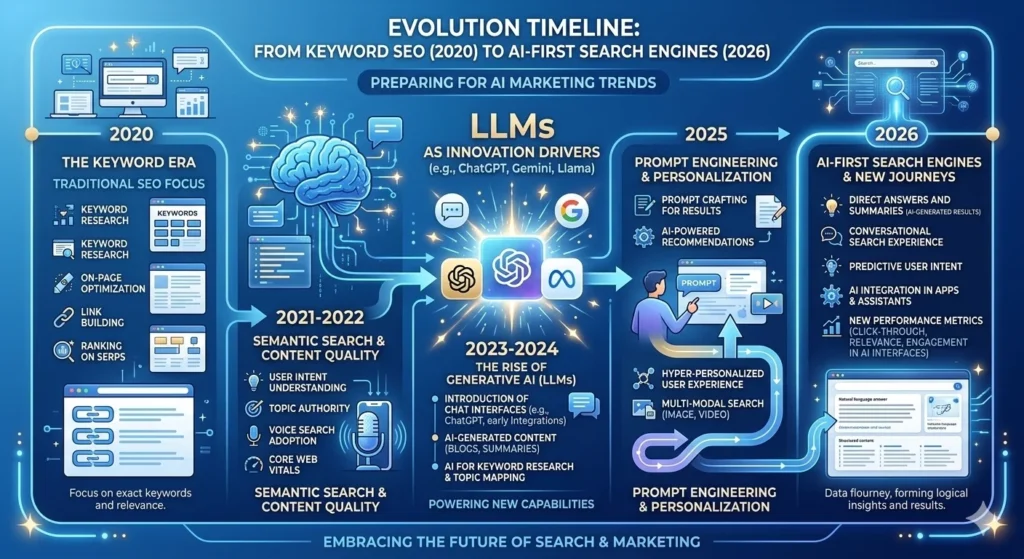
Remote and hybrid work have become a permanent part of the global employment landscape, not a temporary response to the pandemic. Industry analyses indicate that a significant share of companies now operate fully remote models and that a notable portion of the global workforce works remotely full time, normalizing cross-border hiring and collaboration. At the same time, markets such as the UK and Europe are facing persistent skills shortages in sectors like IT, engineering, healthcare, logistics, and education, making it difficult and expensive to fill roles with local candidates alone.
These pressures are particularly visible in staffing and recruitment agencies, which must deliver qualified candidates faster while dealing with higher job board costs, rising recruiter salaries, and shrinking margins. Offshore recruiters address this by tapping into talent-rich regions such as India and the Philippines, where there are large pools of multilingual, technically skilled professionals who are comfortable working in global teams.
Across mature labour markets, agencies and in-house TA teams face intense cost pressure as salaries, office expenses, and technology subscriptions rise faster than client fees. Offshore recruitment companies offer delivery models that can reduce operational recruitment costs by 40–60 percent while maintaining or improving quality, primarily by shifting execution work—sourcing, screening, coordination, and admin—to lower-cost markets run by specialist teams.
In addition, offshore staffing providers frequently absorb infrastructure, HR, payroll, and compliance overheads, allowing client organisations to convert fixed costs into variable, scalable fees. For example, remote staffing and offshore team operators in India offer models where they provide office space, IT equipment, HR administration, and compliance frameworks, while the client only pays for the talent and agreed service.
Client expectations for speed have changed sharply, particularly in contingent staffing and project-based hiring, where CVs are expected within hours rather than days. Offshore recruiters give agencies and employers near 24/7 sourcing and candidate engagement by working across time zones and extending delivery hours beyond the client’s local business day.
Many leading offshore recruitment providers maintain access to large global CV databases, multiple job boards, and AI-enabled sourcing tools that accelerate candidate identification and matching. Combined with structured processes, this enables higher candidate volumes, faster shortlists, and improved time-to-submit metrics compared to traditional in-house-only models.
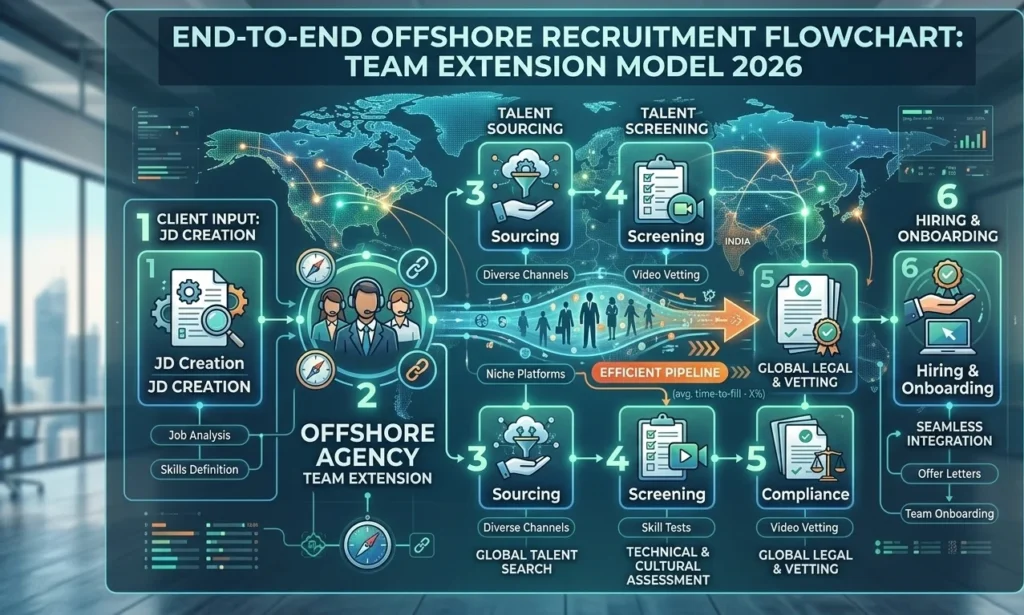
Offshore recruitment refers to the process of sourcing, screening, and hiring talent in one country to work for organisations based in another country, usually delivered by recruitment process outsourcing (RPO) providers or specialist agencies. These offshore recruitment agencies act as an extension of the client’s internal talent acquisition or staffing team, taking on tasks such as job description creation, candidate sourcing, CV screening, interviewing support, background checks, and coordination of offers.
Unlike traditional third-party recruiters who operate entirely in the client’s home market, offshore recruiters are based in different, often lower-cost geographies and are structured to support multiple time zones, currencies, and regulatory regimes. Their teams typically specialise by industry—such as IT, healthcare, finance, or manufacturing—and are trained to understand client cultures, local employment standards, and sector-specific compliance requirements.
While each provider packages services differently, most top offshore recruiters in 2026 to build best teams offer some or all of the following service lines:
End-to-end RPO: Managing the full recruitment lifecycle from requisition intake through offer acceptance and onboarding support.
Sourcing and lead generation: Building pipelines of qualified candidates through job boards, social networks, talent communities, and direct outreach.
Screening and assessment: Conducting CV reviews, skills assessments, initial interviews, and cultural fit evaluations.
Compliance and background checks: Handling employment verification, reference checks, criminal records, education verification, and other background screening.
Administrative and back-office support: Managing interview scheduling, candidate communication, ATS data entry, and recruitment reporting.
Employer branding and talent engagement: Supporting content, messaging, and campaigns to position the client as an attractive employer in offshore markets.
Some offshore teams also extend beyond recruitment into broader remote staffing and offshore team operations, including HR administration, payroll, local contracts, workplace infrastructure, and performance tracking.
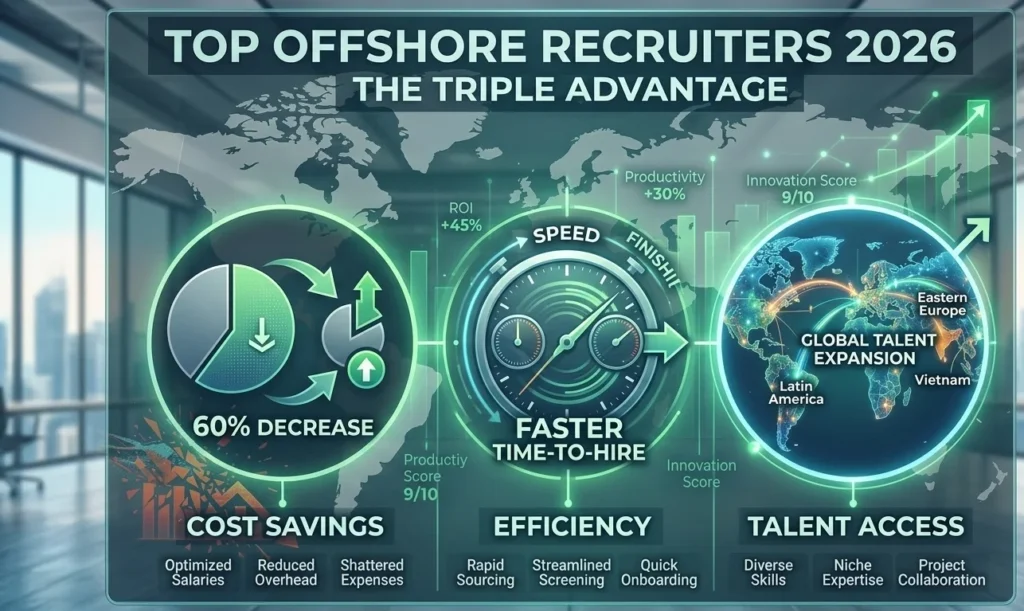
One of the most compelling reasons to use offshore recruiters is the potential for substantial cost savings without sacrificing quality. Case studies from experienced providers in the UK and European markets show that agencies can cut operational recruitment costs by 40–60 percent through offshore support while maintaining or even improving delivery metrics.
Remote staffing and offshore team companies based in India and similar markets report total hiring cost reductions of up to 60 percent when accounting for salaries, benefits, and infrastructure overhead compared with hiring equivalent talent in high-cost regions such as the US or Western Europe. In addition, clients avoid the fixed cost of maintaining large in-house recruiting teams, converting expenditure into flexible monthly retainers or per-hire fees.
Top offshore recruiters in 2026 to build best teams are designed to increase throughput and speed. Providers with long experience supporting UK recruitment firms report time-to-hire reductions of around 30 percent (for example, from 19 to 13 days) as a result of extended sourcing coverage, AI-enabled tools, and process optimisation.
For staffing agencies that operate on VMS or MSP programmes, offshore teams that plug into vendor management systems can handle high-volume requisitions, CV submittals, and compliance tasks at pace, improving scorecard performance and interview ratios without inflating internal headcount. Remote recruitment agencies focused on globally distributed teams similarly emphasise speed: some highlight rapid deployment of remote professionals and complete teams within days rather than months by combining pre-vetted talent pools with embedded delivery models.
Demand for niche skills and multilingual capability has outpaced what many local markets can supply, especially in domains such as software engineering, data, cybersecurity, healthcare, and advanced manufacturing. Offshore recruitment partners address this by maintaining access to large CV databases, multi-country job boards, and proprietary talent networks in talent-rich regions like India, the Philippines, and parts of Africa.
Specialised offshore RPO providers highlight their ability to build teams for hard-to-fill roles, such as trilingual customer support or specialised developers, drawing on global sourcing strategies that go far beyond a single domestic market. Remote-first recruitment agencies that focus on distributed knowledge workers similarly position themselves as gateways to “US-level” or “EU-level” talent regardless of physical location, helping clients access skills that would otherwise be unaffordable or unavailable locally.
Because offshore recruiters work in time zones that complement client markets, they can maintain candidate engagement beyond local business hours, reducing drop-offs and improving responsiveness. Staffing firms supporting shift-based or healthcare roles benefit from offshore teams that can handle late-night calls, urgent bookings, and last-minute schedule changes, giving end clients round-the-clock coverage.
In parallel, remote staffing providers that combine recruitment with ongoing HR and performance management offer regular reporting, structured communication, and dedicated account management, helping both clients and candidates feel supported throughout the employment lifecycle. This combination of speed, availability, and structure is a key differentiator for top offshore recruiters in 2026 to build best teams that stay engaged and productive over the long term.

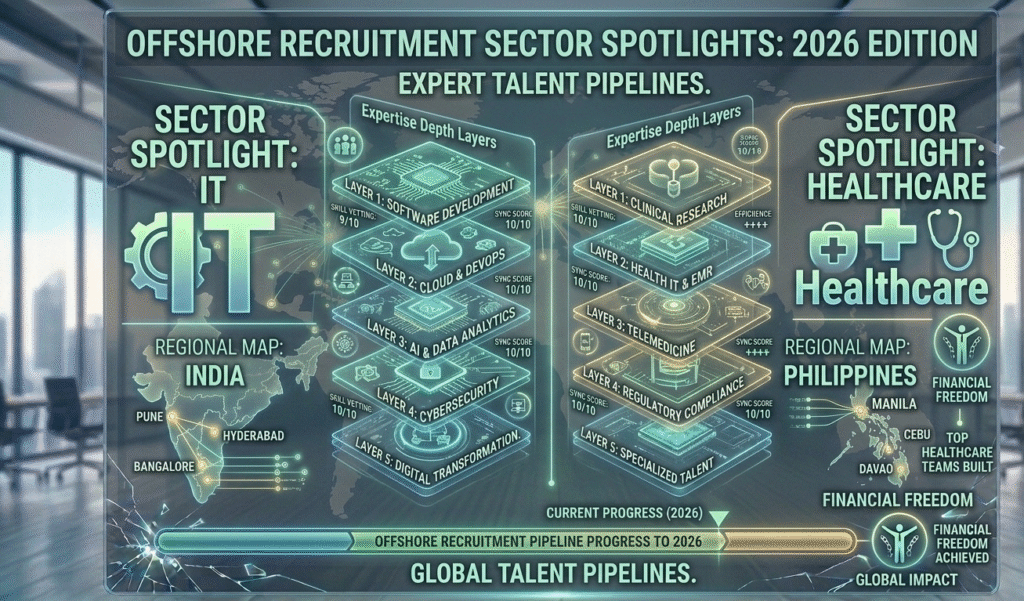
The best offshore recruiters do not try to be everything to everyone; they focus on specific industries, role types, and geographies where they have proven expertise. For example, some specialise in healthcare, IT, engineering, or education for UK and European markets, while others focus on technology and professional roles for North American clients.
Sector specialisation improves sourcing accuracy, reduces ramp-up time, and leads to better-quality submissions because recruiters understand the terminology, required skills, and local regulatory nuances of the roles they support. Similarly, regional expertise—in areas such as GDPR for Europe or employment standards in North America—ensures offshore teams can operate compliantly and align with local expectations around candidate communication and data handling.
Top offshore recruiters in 2026 to build best teams invest heavily in process design and technology. Many use AI-driven sourcing tools, advanced Boolean search, and integrated ATS workflows to accelerate candidate identification and ranking. They also implement standard operating procedures for sourcing, screening, and submission, including quality checks and feedback loops.
Leading providers emphasise clear workflows documented in project management tools, consistent use of applicant tracking systems (often the client’s own ATS), and role-based access to vendor management platforms to handle contingent and VMS hiring. This gives clients transparency and control while allowing offshore teams to drive efficiency and scale.
Successful offshore partnerships rely on more than technical skill; communication style and cultural fit are equally important. Reports from companies building offshore teams in India and elsewhere highlight the importance of recruiters who communicate clearly, take ownership, and adapt smoothly to distributed work environments.
Top offshore recruiters invest in training around stakeholder management, expectation setting, and cross-cultural communication so their teams can integrate into client workflows and represent the client brand effectively in candidate interactions. Many also build local leadership layers—team leads and project managers—who act as bridges between offshore delivery teams and onshore stakeholders, ensuring consistent alignment.
If you only watch sessions and CTR, you will under‑value AI‑driven discovery and potentially cut the very efforts that are driving pipeline.
In 2026, data protection and compliance are non-negotiable for offshore recruitment. The best providers adopt strong information security policies, adhere to frameworks such as GDPR for European data, and build controls into their workflows for handling candidate information.
Remote staffing and offshore team operators differentiate themselves by managing local contracts, payroll, tax, and HR administration in line with local laws, removing significant risk and administrative burden from the client. Their governance models typically include monthly reporting, defined KPIs, and structured review meetings, which help clients monitor performance and remain compliant while scaling offshore capabilities.
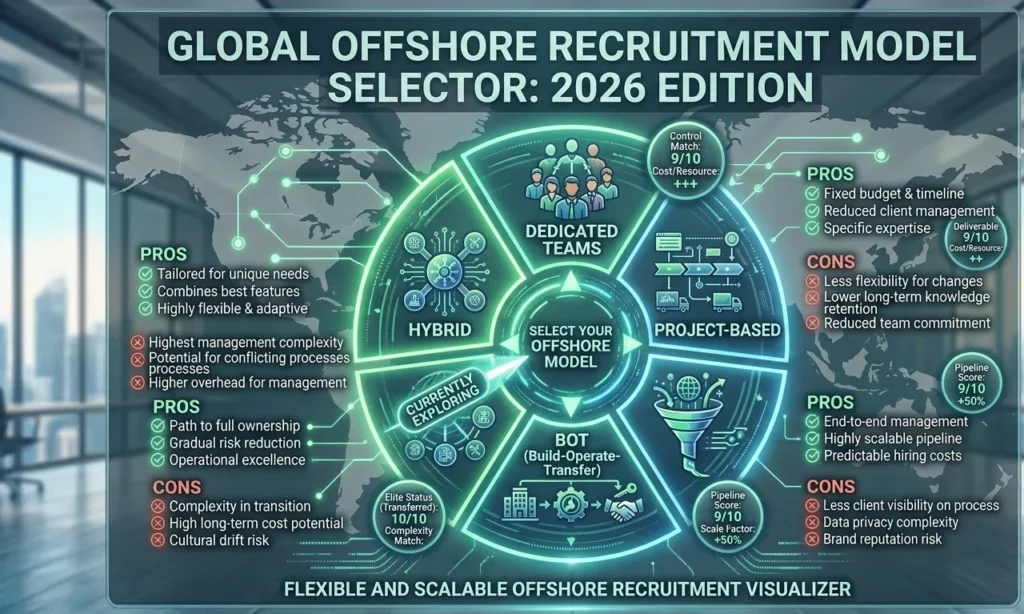
One common model is to engage dedicated offshore recruiters or teams who work exclusively or primarily on the client’s requisitions, often functioning as an embedded extension of the in-house talent acquisition team. Clients typically pay a monthly fee per recruiter, and the offshore team follows the client’s processes, tools, and brand guidelines.
This model works well for staffing agencies and employers with consistent or growing hiring volumes, because it creates continuity, improves institutional knowledge, and allows offshore recruiters to become experts in the client’s roles and culture over time. Dedicated teams can cover sourcing, screening, admin, and sometimes full-cycle recruitment depending on the client’s needs.
For peak hiring seasons, product launches, or transformation projects, some clients prefer project-based offshore recruitment, where a team is assembled for a defined period and scope of work. Remote staffing and offshore team providers describe this as ideal for fixed-duration assignments or specific campaigns where speed and volume are more important than long-term continuity.
Under this model, the offshore partner agrees to deliver a certain number of hires, shortlists, or recruitment tasks within a set timeframe, often using blended pricing that combines fixed fees with performance-based components. Once the project is complete, the engagement can scale down or transition into a different model.
Full recruitment process outsourcing involves a provider taking ownership of most or all recruitment activities, sometimes across multiple geographies or business units. In offshore contexts, RPO providers handle everything from workforce planning and job design to sourcing, assessment, offers, and onboarding coordination, with dedicated offshore teams supporting the model.
Some global staffing and remote team operators also offer build-operate-transfer (BOT) models, where they set up and run an offshore centre or team on behalf of the client and then transfer ownership after an agreed period. This allows organisations to de-risk entry into new talent markets while ultimately gaining their own captive offshore capability.
Hybrid models combine local and offshore recruiters or mix direct employment with third-party remote staffing arrangements. For example, a company might keep strategic roles and final interviews in-house while using offshore recruiters for sourcing, screening, and pipeline building, or they might employ key leaders locally and staff the rest of the team through an offshore operator.
Remote staffing providers highlight multiple engagement models, including full-time dedicated remote professionals, project-based offshore teams, and blended configurations that flex according to project needs. This flexibility is particularly attractive in 2026, when demand can fluctuate rapidly across industries and geographies.
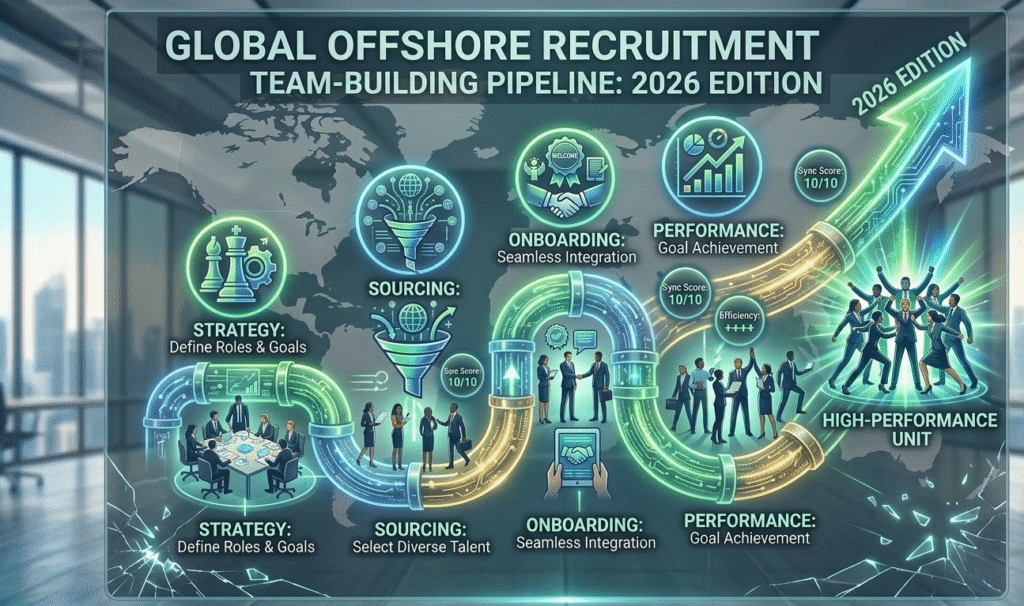
Before sourcing starts, experienced offshore recruiters work with clients to clarify business objectives, role definitions, and engagement horizons. Guidance from offshore team-building experts stresses the importance of defining whether the goal is cost efficiency, capacity expansion, specialised skills, or long-term capability building, because this shapes hiring models, compensation structures, and leadership investment.
Offshore recruitment specialists also advise on which roles are best suited to offshore delivery, how to mix junior and senior profiles, and what language, time zone, and cultural competencies are required for success in each team.
Once the talent strategy is clear, top offshore recruiters leverage a blend of local job portals, global job boards, LinkedIn, proprietary databases, and referral networks to identify suitable candidates. In markets like India, major platforms such as Naukri.com and Indeed India remain key channels, supplemented by curated talent networks and pre-vetted candidate pools maintained by offshore development or staffing companies.
Screening focuses on both technical skills and soft attributes such as communication, problem-solving, and accountability, which multiple sources highlight as critical for success in distributed teams. Offshore recruiters conduct initial interviews, assessments, and background checks, then present a shortlist of vetted candidates, often with structured scorecards and notes to streamline client decision making.
Building the best offshore teams requires robust onboarding and integration, not just hiring. Providers experienced in offshore team setups emphasise onboarding programs that set expectations around delivery standards, communication tools, workflows, escalation paths, and collaboration rhythms from the first week.
Remote staffing and offshore team operators that manage HR and payroll additionally support contract management, local benefits, security protocols, and tool provisioning, ensuring that new hires are productive quickly and feel part of a coherent organisation rather than isolated contractors. Many also encourage regular team-building activities, open communication, and recognition practices to foster a unified culture across onshore and offshore locations.
Top offshore recruiters in 2026 to build best teams treat hiring as the start of the relationship rather than the end. They track KPIs such as time-to-hire, cost-per-hire, submittal-to-interview ratio, fill rate, retention, and satisfaction scores, and they use these metrics to refine sourcing channels, screening criteria, and processes.
Some providers produce monthly performance reports and hold regular review meetings to discuss pipeline health, candidate feedback, and opportunities to improve collaboration. This data-driven approach helps clients continuously optimise their offshore recruitment strategy and ensure that teams remain aligned with changing business goals.
Industry content and video guides on the best RPO and offshore recruitment providers frequently highlight large global players that combine onshore consulting with offshore delivery centres. These include well-known RPO brands that offer scalable models for enterprise hiring, blending technology, analytics, and specialist domain expertise across multiple regions.
Alongside these global majors, specialist offshore RPO providers focused on Europe, the UK, and North America are often cited for their depth in particular markets and sectors. Such firms frequently position themselves as premium offshore recruitment partners with options for dedicated recruiters, project-based engagements, and full-cycle RPO, supported by measurable KPIs and documented case studies.
The growth of fully remote and hybrid work has created demand for agencies that specialise in building distributed teams rather than just filling local office roles. Video content on the best remote recruitment agencies for 2025 and 2026 highlights firms that operate on embedded models, working closely with startups and scale-ups to design remote teams, run hiring sprints, and provide ongoing talent advisory alongside recruitment execution.
Some of these remote recruitment agencies differentiate themselves by offering US-level or EU-level talent standards regardless of candidate location, integrating upskilling and AI training into their offering, and structuring pricing around monthly retainers instead of pure per-hire fees. For clients, this creates a bridge between traditional agency models and modern talent-as-a-service approaches optimised for global teams.
Another segment of providers emphasised in recent articles and resources comprises remote staffing and offshore team operators that go beyond recruitment to manage the full lifecycle of remote employment. These companies position themselves as partners for building “borderless workforces,” offering access to pre-vetted talent, HR and payroll management, local compliance, IT infrastructure, and performance tracking under one roof.
Their engagement models range from full-time dedicated remote staffing, where professionals work exclusively for one client, to project-based offshore teams, hybrid configurations that combine local and offshore talent, and build-operate-transfer structures for companies that eventually want their own captive centres. Such operators are particularly attractive for organisations that want to scale fast without building their own legal entities or HR operations in each target country.
Offshore IT staffing remains one of the most mature segments of the offshore recruitment market, with numerous providers focused on building remote development and technology teams. Guidance from offshore IT staffing specialists emphasises careful recruitment of self-sufficient team members with strong communication skills, tailored approaches to each client’s technology stack, and clear expectations to prevent misalignment in remote work.
Case material from IT-focused offshore recruiters describes how dedicated teams can deliver projects or support ongoing product development while allowing clients to sidestep local skills shortages and reduce costs. These providers frequently work in tandem with broader RPO or staffing firms when clients need to build cross-functional teams that include both technical and non-technical roles.
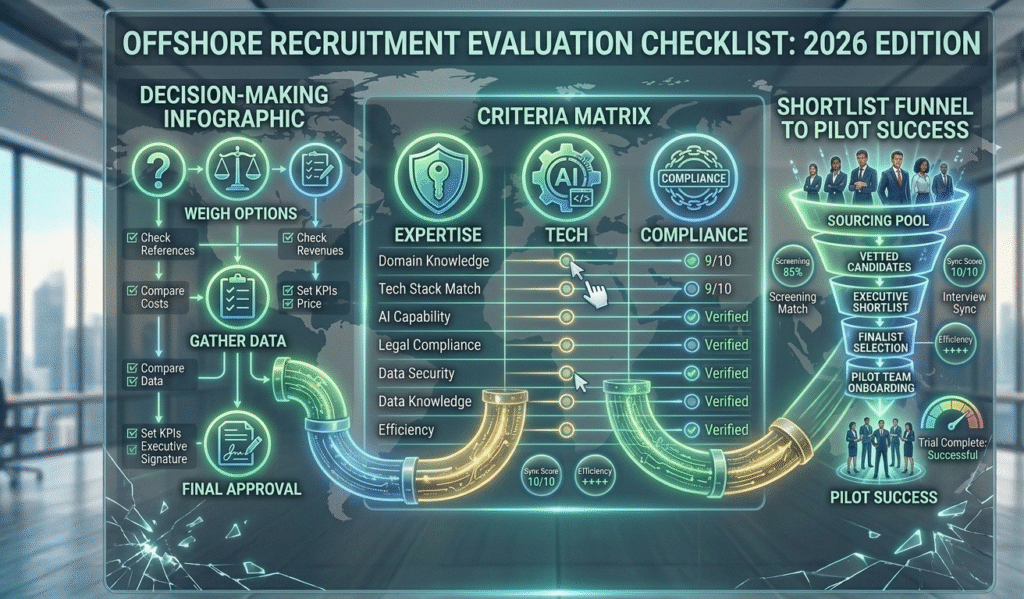
When shortlisting and evaluating top offshore recruiters in 2026 to build best teams, organisations should look at a combination of strategic, operational, and compliance factors.
Evaluation area | What to look for in 2026 | Why it matters |
Sector expertise | Proven track record in your industry (e.g., IT, healthcare, engineering, education) | Reduces ramp time and improves candidate quality |
Geographic focus | Experience with your target markets (UK, EU, US, Canada, ANZ, etc.) and source geographies (India, Philippines, Africa) | Ensures compliance and cultural fit |
Service scope | Clarity on whether they provide sourcing-only, end-to-end RPO, remote staffing, HR/payroll, or BOT | Aligns the model with your internal capabilities |
Technology stack | Use of ATS, VMS, AI tools, analytics, and integration with your systems | Drives efficiency and transparency |
Delivery model | Dedicated recruiters, shared teams, project-based, hybrid, or BOT | Determines flexibility, ownership, and cost structure |
Metrics and reporting | Defined KPIs (time-to-hire, cost-per-hire, fill rate, retention) and cadence of reports | Enables continuous improvement and accountability |
Compliance and security | Policies for data protection, background checks, local labour law compliance | Reduces legal and reputational risk |
Case studies and references | Documented success stories and referenceable clients in similar contexts | Validates claims and de-risks the decision |

A practical selection process typically involves:
Internal alignment: Clarifying why offshore recruitment is needed, which functions and roles will be in scope, and what success looks like in 12–24 months.
Market scan: Researching offshore recruiters with proven experience in the target sectors and regions, including those highlighted in recent RPO and remote recruitment content.
Shortlist and RFI: Creating a shortlist of providers and issuing a request for information (RFI) covering services, models, pricing, and technology.
Deep-dive workshops: Running discovery calls and workshops to understand each provider’s methodology, leadership, and cultural alignment with your organisation.
Pilot engagement: Starting with a pilot—such as a dedicated recruiter, a limited-scope project, or a small remote team—to test collaboration and results before scaling.
Scale-up and optimisation: Expanding the partnership and refining KPIs, workflows, and communication structures based on insights from the pilot.
This disciplined approach helps organisations identify the top offshore recruiters in 2026 to build best teams for their specific context rather than relying solely on generic rankings.
One of the most common mistakes is viewing offshore recruitment purely as a way to reduce expenses without investing in clarity, integration, and local leadership. Experiences shared by offshore team-building experts show that many failed setups stem from unclear requirements, weak local leadership, and limited real-time collaboration rather than lack of talent.
To avoid this, organisations should treat offshore recruiters as strategic partners, align them with business objectives, and appoint empowered stakeholders on both sides to manage the relationship and drive outcomes.
Another frequent pitfall is underestimating the impact of communication style, cultural differences, and time zones on collaboration. Guidance from remote staffing and offshore IT staffing sources emphasises that self-sufficient team members with strong communication skills are critical for success and that structured communication channels and tools are essential to maintain productivity.
Organisations should establish clear meeting cadences, documentation standards, and communication norms early, and ensure that offshore recruiters understand and can represent the company’s culture and employer brand effectively.
Some companies rush into offshore recruitment arrangements without fully considering data protection, employment law, and contractual risk. Reputable offshore partners emphasise their compliance frameworks, including GDPR alignment, secure handling of candidate data, robust background checks, and adherence to local labour regulations.
Due diligence should therefore include a thorough review of information security policies, contracts, and legal structures, as well as clarity on who is the legal employer in each scenario and how liabilities are managed.
Define objectives: Cost savings, speed, access to skills, geographic expansion, or a mix of these.
Map roles: Identify which roles and functions are suitable for offshore delivery based on collaboration needs, regulatory sensitivity, and time zone constraints.
Choose geographies: Decide where to source talent (for example, India for engineering and back office, Latin America for time zone alignment with North America, Eastern Europe for certain technical roles). This step should be informed by both labour market availability and compliance considerations.
Build a shortlist of offshore recruiters with relevant sector and regional expertise, referencing global RPO providers, specialist offshore RPO firms, remote recruitment agencies, and remote staffing operators highlighted in recent analyses.
Evaluate engagement models (dedicated recruiters, project-based, RPO, remote staffing, BOT) and choose the combination that best fits current and future hiring plans.
Negotiate SLAs, KPIs, governance structures, and escalation paths, ensuring alignment on time-to-hire targets, quality standards, and reporting cadences.
Launch a pilot with a limited scope, such as a dedicated recruiter for one business unit or a project to fill a defined number of roles.
Monitor metrics such as submittal volumes, interview ratios, time-to-offer, and candidate feedback, and use these to refine job definitions, screening criteria, and workflows.
Once results are stable, scale the engagement by adding more recruiters, expanding into new role families, or layering in additional services such as remote staffing or HR administration.
Hold regular performance reviews to assess KPIs, process bottlenecks, and emerging skill needs.
Co-invest in training for offshore recruiters on new tools, markets, and employer branding messages so they remain effective ambassadors of the client’s brand.
Periodically benchmark the partnership against market alternatives and internal delivery models to ensure that the chosen offshore recruiters remain the top partners in 2026 to build best teams for the organisation’s evolving strategy.

Offshore recruitment has become a strategic lever for building resilient, high-performing teams in an era defined by remote work, skills shortages, and financial pressure. The top offshore recruiters in 2026 to build best teams combine sector depth, global reach, advanced technology, strong governance, and cultural alignment to deliver cost-efficient, fast, and compliant hiring at scale.
By understanding how offshore recruiters operate, evaluating providers against clear criteria, and following a structured implementation roadmap, organisations can transform offshore recruitment from a tactical cost-saving initiative into a long-term competitive advantage in global talent acquisition.
Offshore recruitment is the process of hiring talent from another country through external recruiters or recruitment partners who source, screen, and manage candidates for companies located in different regions.
Companies increasingly use offshore recruiters to reduce hiring costs, access global talent pools, and speed up recruitment processes while maintaining quality and scalability.
Businesses can reduce recruitment and operational hiring costs by 40–60% by leveraging offshore recruitment teams in talent-rich regions like India and the Philippines.
Most offshore recruiters offer services such as candidate sourcing, CV screening, interview coordination, background checks, recruitment process outsourcing (RPO), and administrative hiring support.

































Ready to elevate your customer experience? Don’t settle for ordinary support. Our dedicated consultants are standing by to match your enterprise with the highest-caliber customer service executives in the USA. From virtual assistants to specialized account managers, we have the expertise and talent pool to meet your needs.
Contact our team today to discuss how our tailored customer executive services can transform your support operations. Let us help you hire or outsource the best customer service executives in USA, so you can focus on growing your business with confidence. Together, we will build a world-class customer support team that drives loyalty and success.

Let our expert recruiters bring the right talent your way- connect with us today!
Fill in the form below to book a free consulting session: